
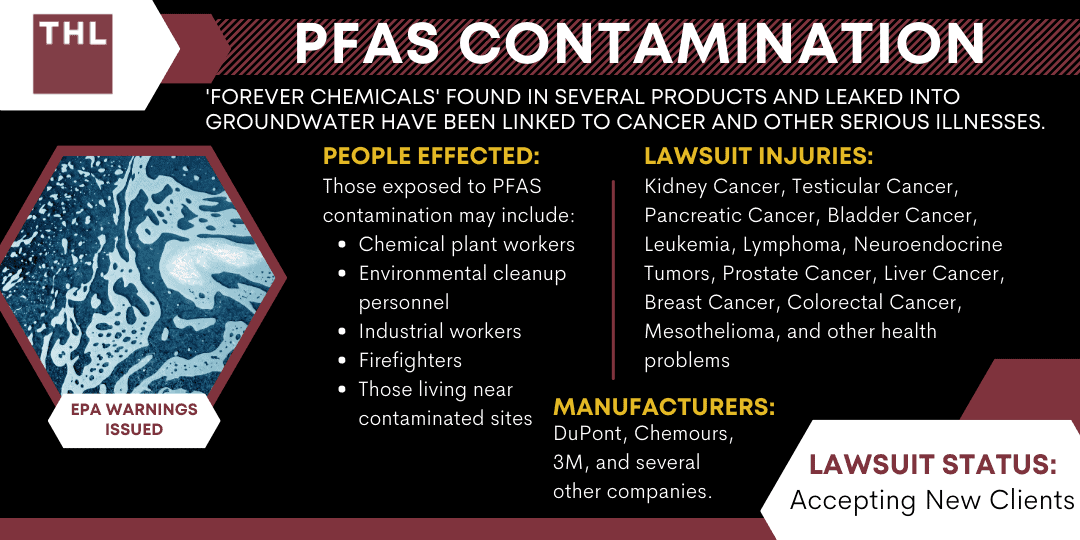
Per- and polyfluoroalkyl substances (PFAS) are a group of man-made chemicals that have been used in various industrial and consumer products since the 1950s for their water- and grease-resistant properties.
PFAS are often referred to as “forever chemicals”.
PFAS accumulate in the body because they resist degradation and bind to proteins, leading to their buildup in blood, liver, and other tissues over time.
Studies have shown that even low levels of exposure to PFAS can significantly increase the risk of health issues such as cancer, liver damage, thyroid disease, decreased fertility, and developmental problems in children.
PFAS contamination of water supplies has affected millions of people, particularly those living near industrial sites, military bases, and airports where these chemicals are commonly used.
As a result of their widespread use and persistence, PFAS contamination has led to numerous lawsuits and regulatory actions aimed at holding manufacturers and polluters accountable for the harm caused.
The History of PFAS
Per- and polyfluoroalkyl substances (PFAS) are synthetic chemicals first developed in the 1940s.
They gained widespread use due to their ability to resist grease, heat, water, and oil.
Major manufacturers like 3M and DuPont began producing PFAS for a variety of applications, including non-stick cookware, water-repellent fabrics, and firefighting foams.
Concerns about the environmental and health impacts of PFAS began to surface in the 1960s and 1970s, with internal studies indicating potential toxicity.
Despite this, the production and use of PFAS continued to grow until the early 2000s when regulatory scrutiny increased and significant efforts to phase out certain PFAS compounds began.
Here is a timeline of events the historical evolution of PFAS chemicals since the 1940s:
1940s: PFAS were first synthesized and introduced for commercial use.
- PFAS were first developed and introduced by 3M and DuPont for their unique water and oil-resistant properties.
- Initially used in non-stick cookware (e.g., Teflon) and water-repellent fabrics due to their chemical stability and durability.
1950s-1960s: PFAS began to be widely used in consumer products and industrial applications.
- PFAS usage expanded into a variety of consumer products and industrial applications, including firefighting foams, textiles, and paper products.
- Internal studies by manufacturers and military organizations began to reveal potential environmental and health impacts, although these findings were not widely publicized.
- After the 1967 USS Forrestal fire, the US Military made it mandatory to carry AFFF foam on ships.
1970s: Growing awareness of the environmental persistence of PFAS, as they were found to resist degradation in the environment and accumulate in living organisms.
- Studies indicated the chemicals’ potential toxicity to aquatic life and possible health risks to humans.
- The military’s extensive use of Aqueous Film-Forming Foam (AFFF) containing PFAS for firefighting training and emergency response highlighted significant contamination risks to soil and groundwater near bases.
- Research and internal reports by manufacturers and the military confirmed the toxic nature of PFAS, leading to calls for better management and regulation, although substantial regulatory actions were still lacking.
1980s: Despite growing awareness, the production and use of PFAS compounds expanded.
- PFAS remained prevalent in various industrial applications and consumer products, such as non-stick cookware and stain-resistant fabrics.
- Research began to uncover the widespread environmental presence of PFAS, raising concerns about their long-term ecological impacts.
- Regulatory bodies started to monitor PFAS contamination, particularly in water sources near manufacturing sites, but comprehensive regulations were not yet in place.
1990s: Growing scientific data on the health effects of PFAS begin to influence industry changes.
- Increased scientific research linked PFAS exposure to various health issues, including developmental problems and potential carcinogenic effects.
- Some manufacturers began voluntarily phasing out specific PFAS compounds like PFOA and PFOS in response to growing health concerns
- Environmental agencies, such as the EPA, started developing guidelines and advisories for PFAS in drinking water, marking the initial steps toward regulatory control.
2000s: Regulatory agencies started to take action, leading to the phase-out of some PFAS compounds.
- Certain compounds, such as PFOA and PFOS, were phased out under pressure from environmental groups and regulatory bodies.
- The first major lawsuits emerged as communities and environmental organizations sued manufacturers for contamination and health impacts. Notable cases included those against 3M and DuPont.
2010s-present: Increased regulatory actions and public awareness led to significant legal and cleanup efforts.
- The EPA and other international regulatory bodies implemented stricter regulations on PFASlevels in drinking water and other environments.
- This includes the establishment of Maximum Contaminant Levels (MCLs) for several PFAS compounds.
- Legal battles continue as more communities discover PFAS contamination in their water supplies. Manufacturers and the military face numerous lawsuits related to health impacts from PFAS exposure.
- Public awareness has surged, leading to significant cleanup efforts funded by government initiatives, such as the Bipartisan Infrastructure Law, which allocates billions of dollars to address PFAS contamination.
Recent Government Regulation on PFAS Chemicals
The U.S. Environmental Protection Agency (EPA) has taken significant steps to regulate PFAS chemicals due to their persistent and harmful effects on human health and the environment.
Recently, the EPA and the White House finalized the first-ever National Primary Drinking Water Regulation for six PFAS, setting enforceable limits to protect public health.
This rule mandates public water systems to monitor and reduce PFAS levels, aiming to prevent thousands of deaths and serious illnesses related to these chemicals.
The EPA also proposed designating PFOA and PFOS as hazardous substances under the Comprehensive Environmental Response, Compensation, and Liability Act (CERCLA).
This designation will require immediate reporting of significant releases and facilitate cleanup efforts, ensuring polluters are held accountable.
The EPA’s PFAS Strategic Roadmap outlines a comprehensive approach to addressing PFAS contamination, including $10 billion in funding from the Bipartisan Infrastructure Law to support testing, monitoring, and treatment efforts across the country.
