(888) 508-6752

Child Personal Injury Claims: How Are They Handled?

Published By:
Picture of Tor Hoerman
Tor Hoerman

Tor Hoerman has represented injured individuals for more than 30 years, with experience spanning individual personal injury cases and nationwide mass tort litigation. His work includes car accidents, catastrophic injuries, product liability claims, and other serious injury cases. Tor has served in court-appointed leadership roles in national litigation and tried cases involving major corporate defendants.

TorHoerman Law’s legal content is researched and written by our editorial team and attorneys for legal accuracy, clarity, and relevance. We rely on statutes, court records, government publications, medical research, and other authoritative sources when applicable. This page provides general legal information and does not constitute legal advice.

TorHoerman Law reviews its legal content for factual accuracy, current information, and relevant legal context before publication and as material developments occur. This article is provided for general informational purposes and does not constitute legal advice. For guidance about a specific case, contact TorHoerman Law.

How Are Child Personal Injury Claims Handled?

A personal injury case involving an injured child is handled differently from an adult claim because a minor generally cannot pursue or settle the case independently.

When a child is harmed because of someone else’s negligence, an authorized adult representative may be able to seek financial compensation on the child’s behalf for medical care, pain and suffering, disability, future losses, and other recoverable damages.

Legal differences may affect who can file the claim, how deadlines apply, whether a court must approve a settlement, and how the child’s recovery is protected.

Child injury claims also require careful consideration of future development, education, long-term medical needs, and earning capacity.

TorHoerman Law helps families understand the procedures that apply to a child’s personal injury claim and the steps required to protect the child’s legal interests.

Child Personal Injury Claims How Are They Handled

Was Your Child Injured at No Fault of Their Own? Contact Us Today

When an injured minor suffers harm because of another person or entity’s negligence, a parent, guardian, or other authorized representative may be able to pursue a personal injury claim on the child’s behalf.

A child injury claim may arise from a car accident, unsafe property condition, defective product, negligent supervision, medical negligence, or another incident that causes legally compensable harm.

Personal injury compensation may include the child’s medical expenses, future treatment and care, pain and suffering, permanent impairment, and other damages recognized under applicable state law.

Because children may still be developing physically, cognitively, and emotionally, serious injuries can also affect education, independence, future earning capacity, and the child’s well being and financial future.

Legal representation can help families document these present and future losses, identify responsible parties, preserve evidence, and determine which filing deadlines and procedural requirements apply.

The family’s rights may also differ from the child’s rights because a parent may have a separate claim for certain expenses or losses under some state laws.

Settlements involving minors are handled under special procedures in many jurisdictions, which may require court approval and restrictions on how the child’s settlement funds are held, invested, or distributed.

For these reasons, a child personal injury claim requires careful evaluation of both the immediate injury and the long-term consequences the child may face.

Contact TorHoerman Law for a free consultation to discuss your child’s injury and the legal options available to your family.

Table of Contents

What Is a Child Personal Injury Claim?

A child personal injury claim allows an injured minor to seek compensation when another person, business, organization, or other liable party causes harm through negligence or another legally recognized basis for liability.

Child injury claims generally follow many of the same liability, causation, and damages principles as cases involving adults, but additional protections apply because minors typically cannot manage or settle legal claims independently.

A parent or guardian, court-appointed representative, or other person authorized under applicable law may therefore take an active role in pursuing the claim on the child’s behalf.

Compensation may address medical treatment, pain and suffering, permanent impairment, future care, and other losses affecting the child’s life.

State law may also determine whether a parent has a separate claim for certain medical expenses or other losses associated with the injury.

What Is a Child Personal Injury Claim

Filing deadlines require particular attention because some states toll, or pause, certain statutes of limitations while the injured person is a minor, sometimes until age 18 or 19, while other claims remain subject to different or earlier deadlines.

For example, Illinois generally allows certain claims to be brought within two years after a minor reaches age 18, illustrating why the applicable state law must be reviewed rather than assuming every child’s claim remains open until adulthood.

These additional procedural protections are intended to preserve the injured child’s legal interests while allowing an authorized adult to pursue the claim and seek compensation on the child’s behalf.

Who Can File a Personal Injury Claim for a Child?

Who can file a personal injury claim for a child depends on state law, the court involved, and the child’s family and custody circumstances.

A parent or legal guardian commonly begins an insurance claim and retains legal counsel on the child’s behalf.

If a lawsuit is filed, applicable law may require the child to proceed through a parent acting in a representative capacity, legal guardian, next friend, conservator, or another authorized representative.

What Is a Child Personal Injury Claim; Who Can File a Personal Injury Claim for a Child

Potential representatives may include:

  • A parent: A parent may be authorized to act on the child’s behalf, subject to applicable state law and any custody or court orders.
  • A legal guardian: A court-appointed guardian may have authority to pursue or manage a claim for the child.
  • A next friend: Some jurisdictions permit a competent adult, often a parent, to bring a lawsuit on behalf of a minor who lacks another authorized representative.
  • A guardian ad litem: A court may appoint a guardian ad litem to independently protect the child’s interests, particularly when a conflict exists or a settlement requires additional judicial review.

A custody order does not necessarily determine who has authority to file a lawsuit, retain counsel, sign legal documents, or approve a settlement on the child’s behalf.

Disputed custody, deceased or unavailable parents, conflicts of interest, or competing claims may require additional court involvement or appointment of an independent representative.

Can a Child File a Personal Injury Lawsuit Without a Parent?

A minor generally cannot prosecute a personal injury lawsuit or enter a binding settlement independently.

If a parent is unavailable, unwilling or unable to act, involved in the circumstances of the injury, or has a conflict of interest with the child, another representative may be authorized or appointed under applicable law to protect the child’s interests.

In federal court, for example, a minor without a duly appointed representative may sue through a next friend or guardian ad litem.

Can Both Parents File a Claim for the Same Injury?

The child’s injury does not generally allow both parents to recover duplicate compensation for the same damages.

State law determines who may act on the child’s behalf and whether either parent has a separate claim for medical expenses, necessary care, loss of services, or other legally recognized losses arising from the child’s injury.

When parents are separated or divorced, custody orders and other court documents may affect who has authority to make decisions concerning the child’s claim.

Conflicts between parents, competing claims, or disagreements over settlement allocation may also require additional court review before a settlement can be approved or funds distributed.

What Types of Accidents Lead to Child Personal Injury Claims?

A personal injury claim involving a child can arise from any event in which legally actionable conduct causes harm.

Common cases involve motor vehicles, unsafe property, defective products, negligent supervision, medical treatment, and intentional misconduct.

What Is a Child Personal Injury Claim; Who Can File a Personal Injury Claim for a Child; What Types of Accidents Lead to Child Personal Injury Claims

Common types of accidents that may lead to child personal injury claims include:

  • Car, truck, and rideshare crashes: A child may be injured as a passenger, pedestrian, cyclist, or occupant of a school vehicle.
  • Pedestrian and bicycle accidents: Drivers may fail to yield, speed near schools, or overlook children in crosswalks.
  • Daycare and school injuries: Claims may involve inadequate supervision, unsafe facilities, negligent hiring, transportation incidents, or failure to follow safety procedures.
  • Playground and premises injuries: Broken equipment, unsafe surfaces, unsecured pools, dangerous stairs, or inadequate maintenance may cause serious harm.
  • Dog bites and animal attacks: Liability may depend on ownership, prior knowledge, leash laws, negligence, and state-specific animal liability rules.
  • Defective children’s products: Unsafe toys, cribs, car seats, medications, appliances, and other products may support product-liability claims.
  • Medical malpractice: Birth injuries, medication errors, delayed diagnosis, surgical errors, and other departures from the standard of care may cause permanent injury.
  • Sports and recreational injuries: Liability may arise from defective equipment, reckless conduct, inadequate emergency response, or risks beyond those ordinarily inherent in the activity.
  • Abuse or assault: Civil claims may be available against the perpetrator and, in appropriate cases, an institution or other party whose conduct enabled the harm.
  • Attractive nuisances: Pools, machinery, abandoned structures, and similar hazards may trigger special duties toward children under some states’ premises-liability rules.

What Must Be Proven in a Child Personal Injury Lawsuit?

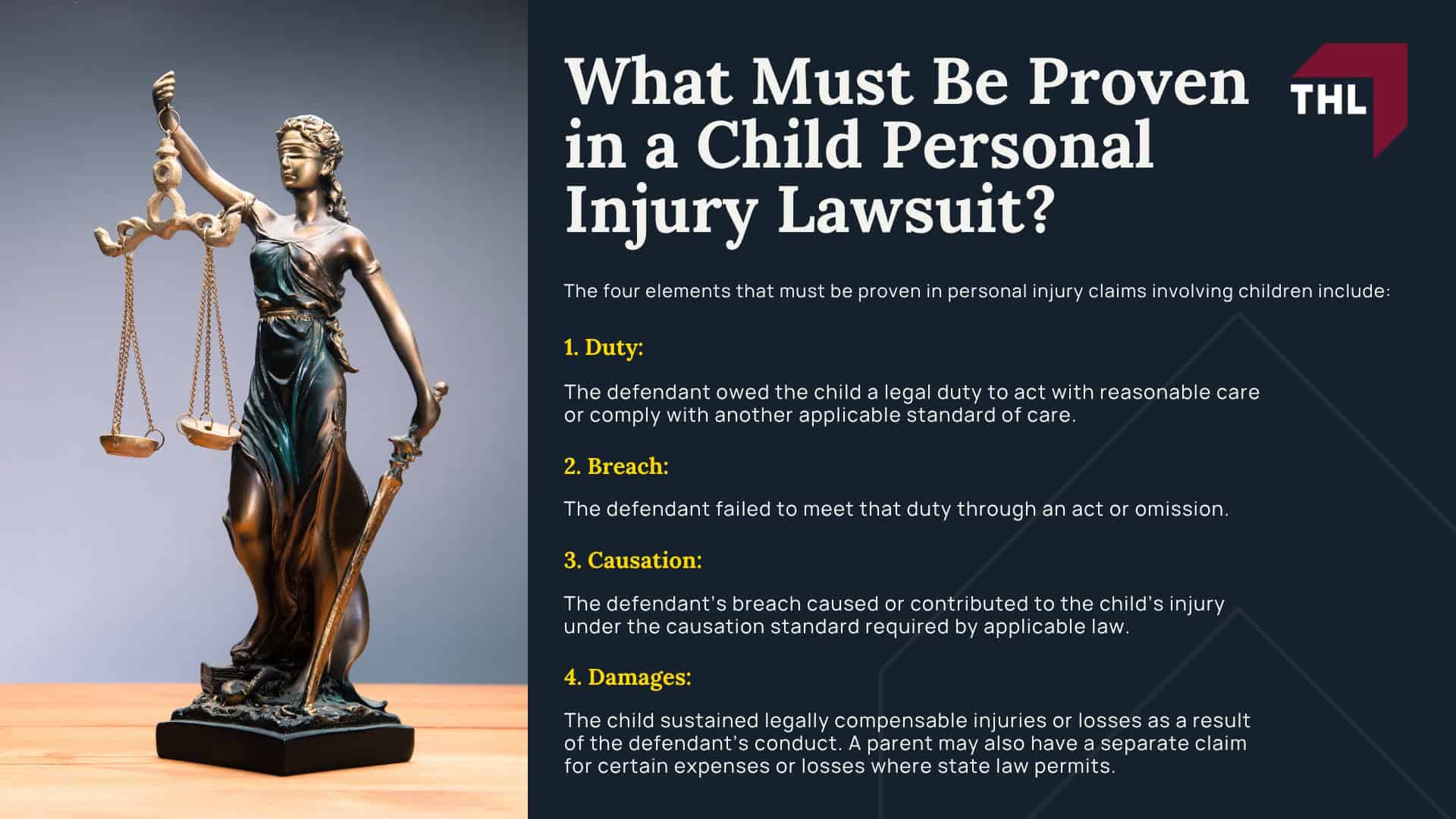
Most child personal injury lawsuits based on negligence require proof of four elements: duty, breach, causation, and damages.

These are the same basic negligence elements that apply in cases involving adults, although a child’s age may affect issues such as comparative fault, testimony, future damages, and the evaluation of the child’s own conduct.
What Is a Child Personal Injury Claim; Who Can File a Personal Injury Claim for a Child; What Types of Accidents Lead to Child Personal Injury Claims; What Must Be Proven in a Child Personal Injury Lawsuit

The four elements that must be proven in personal injury claims involving children include:

  1. Duty: The defendant owed the child a legal duty to act with reasonable care or comply with another applicable standard of care.
  2. Breach: The defendant failed to meet that duty through an act or omission.
  3. Causation: The defendant’s breach caused or contributed to the child’s injury under the causation standard required by applicable law.
  4. Damages: The child sustained legally compensable injuries or losses as a result of the defendant’s conduct. A parent may also have a separate claim for certain expenses or losses where state law permits.

The evidence required depends on how the injury occurred.

In a daycare negligence case, for example, staffing records, surveillance footage, licensing requirements, incident reports, and witness testimony may help establish whether the daycare failed to provide legally required supervision and whether that failure caused the child’s injury.

Can a Child Be Found Partially at Fault?

A child may be found partly responsible for an accident, but minors are not always judged by the same standard of care as adults.

Depending on the jurisdiction, a court may evaluate the child’s conduct in light of factors such as age, intelligence, experience, maturity, and the circumstances surrounding the incident.

Some states also apply special presumptions or rules when determining whether a very young child is capable of negligence.

Comparative and contributory fault rules vary by state.

In comparative-fault jurisdictions, any responsibility attributed to the child may reduce the compensation available, and some states bar recovery once the plaintiff’s share of fault reaches a specified threshold.

A small number of jurisdictions continue to use contributory-negligence rules that can bar recovery when the plaintiff is legally responsible for contributing to the injury.

An exception may apply when a minor engages in certain activities ordinarily associated with adults.

For example, some courts hold minors operating motor vehicles to the same standard of care that applies to adult drivers.

What Evidence Is Needed for a Child Personal Injury Claim?

Evidence in a child personal injury claim may be used to establish how the incident occurred, the nature and cause of the child’s injuries, the treatment provided, and the effect of the injury on development, education, daily activities, and future needs.

Because younger children may have difficulty identifying or describing symptoms, observations from parents, caregivers, teachers, therapists, and medical professionals can provide important context when documenting changes after an injury.

What Is a Child Personal Injury Claim; Who Can File a Personal Injury Claim for a Child; What Types of Accidents Lead to Child Personal Injury Claims; What Must Be Proven in a Child Personal Injury Lawsuit; What Evidence Is Needed for a Child Personal Injury Claim

Relevant evidence may include:

  • Incident evidence: Photographs, videos, police or incident reports, physical evidence, and witness statements.
  • Medical evidence: Emergency treatment records, pediatric records, diagnostic imaging, operative reports, rehabilitation records, prescriptions, and specialist evaluations.
  • Developmental and educational evidence: Developmental assessments, neuropsychological testing, therapy records, school attendance, grades, accommodation plans, individualized education programs, and teacher observations.
  • Financial evidence: Medical bills, insurance records, therapy costs, travel expenses, equipment expenses, and home-modification estimates.
  • Future-care evidence: Medical opinions, life-care plans, vocational assessments, economic projections, and other evidence supporting reasonably anticipated future needs.
  • Daily-impact evidence: Caregiver observations, photographs, activity restrictions, behavioral changes, sleep changes, and limitations on normal childhood activities.
  • Liability evidence: Maintenance and inspection records, employee schedules, training materials, product records, warnings, and other documents relevant to how the injury occurred.

Evidence should be preserved as early as reasonably possible.

Surveillance footage may be overwritten, physical conditions can change, witnesses can become difficult to locate, and electronically stored information or institutional records may not be retained indefinitely.

How Do You Document an Injury When a Child Cannot Explain the Symptoms?

When a child is too young or otherwise unable to describe symptoms clearly, parents and caregivers can document observable changes without attempting to make their own medical diagnosis.

Depending on the injury, relevant changes may involve sleep, appetite, mobility, behavior, mood, concentration, school performance, participation in normal activities, or the amount of assistance the child needs.

For example, CDC guidance notes that children with concussion symptoms may show changes in sleep, appetite, behavior, balance, concentration, play, or usual activities, and some symptoms may not become apparent until hours or days after the injury.

Similar observations can help medical providers understand how a child’s functioning has changed after other types of injuries.

Parents and caregivers should report those observations accurately to the child’s healthcare providers.

Medical professionals can then evaluate whether the reported changes are consistent with examination findings, diagnoses, and the child’s course of treatment.

School records, therapy notes, teacher observations, and developmental evaluations may also help document changes that emerge over time.

A dated symptom or care journal can be useful in some cases, but entries should remain factual and specific.

Parents should record what they actually observed rather than speculate about diagnoses, causation, or the child’s long-term prognosis.

What Damages Are Available in a Child Personal Injury Claim?

Available damages in a child personal injury claim depend on the applicable state law, the nature and severity of the injury, and the losses supported by the evidence.

Compensation for minors may include both economic damages, such as medical expenses and future care costs, and non-economic damages for physical pain and suffering, emotional harm, and loss of normal life.

Parents may also have a separate right to recover certain expenses they incur while caring for an injured child, although state law determines which losses belong to the parent and which belong to the child.

An attorney can evaluate each category of loss and help the family claim compensation supported by the evidence while pursuing the maximum compensation available under the law.

What Is a Child Personal Injury Claim; Who Can File a Personal Injury Claim for a Child; What Types of Accidents Lead to Child Personal Injury Claims; What Must Be Proven in a Child Personal Injury Lawsuit; What Evidence Is Needed for a Child Personal Injury Claim; What Damages Are Available in a Child Personal Injury Claim

Recoverable damages may include:

  • Past medical expenses: Compensation may cover emergency treatment, hospitalization, surgery, medication, therapy, rehabilitation, and other medical care already provided because of the injury. Medical bills, treatment records, insurance statements, and provider testimony can help establish these losses.
  • Future medical and care costs: A serious injury may require additional surgeries, rehabilitation, medication, medical equipment, attendant care, home modifications, or long-term treatment. Medical opinions, life-care plans, and economic projections may be used to estimate these future needs.
  • Physical pain and suffering: A child may recover compensation for the physical pain, discomfort, and limitations caused by the injury and medical treatment. The severity and duration of the injury, treatment history, and effect on everyday activities can all influence this portion of the claim.
  • Child’s emotional distress and mental anguish: Injuries can cause fear, anxiety, depression, sleep problems, trauma symptoms, behavioral changes, or other psychological effects. Mental-health records, school records, caregiver observations, and testimony may help document the child’s emotional distress.
  • Disability and disfigurement: Compensation may be available for permanent impairment, scarring, loss of mobility or function, or a reduced ability to live independently. Medical evaluations, photographs, and specialist opinions can help establish the extent of these injuries.
  • Child’s loss of normal life: A significant injury may interfere with a child’s ability to play, attend school, participate in sports or activities, socialize with friends, or reach developmental milestones. Evidence from parents, teachers, therapists, and medical professionals can help demonstrate how the injury has affected the child’s daily life.
  • Lost future earning capacity: If a permanent injury is expected to limit the child’s ability to work or earn income as an adult, the claim may include compensation for diminished future earning capacity. Medical, vocational, educational, and economic evidence may be used to estimate the loss.
  • Parental expenses and other recoverable losses: Parents may be able to recover expenses incurred while caring for their injured child, including certain medical costs, necessary transportation or care expenses, and other losses permitted by state law. The availability and ownership of these claims vary by jurisdiction.

Can a Child Recover Damages for Future Lost Income?

A child may be able to recover damages for lost future earning capacity when a permanent injury is expected to limit the child’s ability to work or earn income as an adult.

Because minors usually have little or no employment history, these damages cannot simply be calculated from past wages.

Attorneys and experts may instead evaluate factors such as the child’s age, health before the injury, academic performance, abilities, expected educational path, medical limitations, likely work life, and earnings data for reasonably probable career paths.

Medical, vocational, and economic expert testimony may be necessary to support the calculation.

Claims involving permanent brain injuries, spinal cord injuries, amputations, significant cognitive impairment, or other lifelong disabilities may provide a stronger basis for future earning-capacity damages.

Courts generally require these losses to be supported by reasonable evidence rather than speculation about what the child might have earned.

When Are Punitive Damages Available in a Child Injury Case?

Punitive damages may be available in some child injury cases when the defendant’s conduct was substantially more serious than ordinary negligence.

Rather than compensating the child for a specific loss, punitive damages are intended to punish particularly wrongful conduct and deter similar behavior.

The legal standard varies by state, but punitive damages generally require evidence of conduct such as intentional wrongdoing, fraud, malice, recklessness, or a conscious disregard for the safety of others.

A simple mistake or failure to exercise reasonable care usually is not enough.

Punitive damages may be considered when evidence shows, for example, that a defendant knew of a serious safety hazard and deliberately ignored it, intentionally concealed a dangerous condition, or repeatedly engaged in conduct that created a substantial risk of injury.

Some states limit the amount of punitive damages that can be awarded or restrict them to particular types of claims.

Whether punitive damages are available depends on the facts of the case and the law of the state where the claim is filed.

Who Receives Compensation From a Child Personal Injury Settlement?

Compensation awarded for a child’s injuries generally belongs to the child, even when a parent or guardian brings the personal injury compensation claim on the child’s behalf.

Parents or guardians may file lawsuits for injured minors, but they do not ordinarily receive unrestricted control over money awarded for the child’s damages.

A parent may have a separate right to recover certain losses, such as medical expenses or other costs incurred while caring for the injured child, depending on state law.

What Is a Child Personal Injury Claim; Who Can File a Personal Injury Claim for a Child; What Types of Accidents Lead to Child Personal Injury Claims; What Must Be Proven in a Child Personal Injury Lawsuit; What Evidence Is Needed for a Child Personal Injury Claim; What Damages Are Available in a Child Personal Injury Claim; Who Receives Compensation From a Child Personal Injury Settlement

When both the child and parent have claims, the settlement may allocate specific amounts to each.

How much compensation can a child receive, how the money is distributed, and when the child can access it depend on state law and the terms of the settlement.

Courts may review the allocation to confirm that the settlement protects the child’s best interest and does not improperly shift compensation belonging to the child to another person.

How Is a Child’s Personal Injury Settlement Protected?

Settlements involving minors are often subject to safeguards designed to preserve the child’s compensation until it can be used for appropriate needs or the child reaches adulthood.

Depending on state law, the amount recovered, and the child’s circumstances, the settlement may be placed in a restricted account, trust, structured settlement, or another protected arrangement.

Common methods of protecting a minor’s settlement include:

  • Restricted or court controlled account: Settlement funds may be deposited into an account that prevents withdrawals without court authorization or until the child reaches the age specified by law or court order.
  • Structured settlement: Some or all of the recovery may fund an annuity that provides payments at designated times rather than giving the child a single lump sum. Structured settlements can preserve compensation for future education, medical care, living expenses, and other long-term needs.
  • Trust: Settlement proceeds may be placed in a trust administered by a trustee under specific rules governing how the money can be used. A special-needs trust may be considered when a child has a qualifying disability and receives or may later receive needs-based public benefits.
  • Guardianship or conservatorship: In some cases, a court appoints an adult to manage the child’s property and requires oversight, financial reporting, or court authorization for certain expenditures.

The appropriate arrangement depends on factors such as the child’s age, the size of the settlement, expected medical and care needs, disability status, and applicable state law.

The settlement serves to compensate the child for an injury, but the way those proceeds are protected can determine whether sufficient funds remain available for future needs.

Does a Court Have to Approve a Child Personal Injury Settlement?

Court approval of a minor’s personal injury settlement depends on state law, the amount of the settlement, and whether a lawsuit has already been filed.

Many jurisdictions require judicial approval in at least some circumstances because a minor generally cannot enter into a binding settlement or release in the same manner as an adult.

Some states also use monetary thresholds that trigger additional court, guardianship, or settlement-protection requirements.

A $15,000 threshold is used for certain minor-settlement procedures in some jurisdictions, although the specific rule and amount vary by state.

When approval is required, the court may consider:

  • The circumstances of the accident and the strength of the child’s claim;
  • The child’s injuries, prognosis, and anticipated future treatment;
  • The total settlement amount and proposed deductions;
  • Attorney fees, litigation costs, medical liens, and reimbursement obligations;
  • Any division of the recovery between the child and a parent;
  • How the child’s settlement proceeds will be held or invested; and
  • Whether the proposed settlement is fair and in the child’s best interest.

A court may also appoint a guardian ad litem to independently protect the child’s interests during the settlement process.

The judge may require medical records, settlement documents, financial information, testimony, or other evidence before approving the agreement.

Court approval can also determine how the child will receive the proceeds, including whether funds must be deposited into a restricted or court controlled account, placed in a trust, or distributed through structured payments rather than as a lump sum.

A parent’s agreement to a settlement does not necessarily create a binding release of the child’s personal injury rights when the procedures required by state law have not been followed.

How Long Do You Have to File a Child Personal Injury Lawsuit?

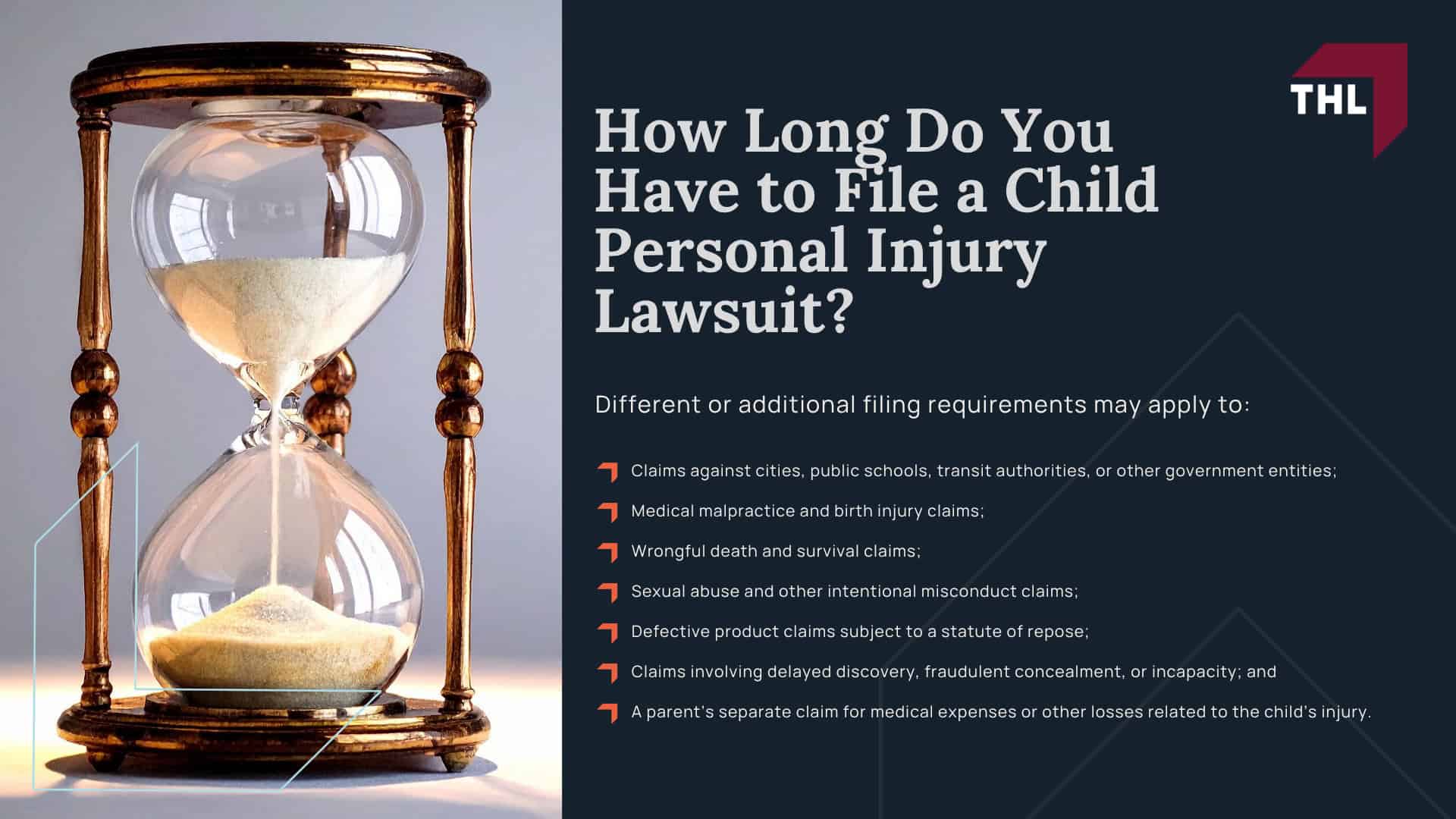
The deadline to file a child personal injury lawsuit depends on the applicable statute of limitations and the type of claim involved.

Some states toll, or pause, the statute of limitations while an injured person is a minor, potentially giving the child additional time to file after reaching adulthood.

Other states impose different deadlines for minors, establish an outside filing deadline, or apply separate rules to claims belonging to the child’s parents.
What Is a Child Personal Injury Claim; Who Can File a Personal Injury Claim for a Child; What Types of Accidents Lead to Child Personal Injury Claims; What Must Be Proven in a Child Personal Injury Lawsuit; What Evidence Is Needed for a Child Personal Injury Claim; What Damages Are Available in a Child Personal Injury Claim; Who Receives Compensation From a Child Personal Injury Settlement; How Long Do You Have to File a Child Personal Injury Lawsuit

Different or additional filing requirements may apply to:

  • Claims against cities, public schools, transit authorities, or other government entities;
  • Medical malpractice and birth injury claims;
  • Wrongful death and survival claims;
  • Sexual abuse and other intentional misconduct claims;
  • Defective product claims subject to a statute of repose;
  • Claims involving delayed discovery, fraudulent concealment, or incapacity; and
  • A parent’s separate claim for medical expenses or other losses related to the child’s injury.

Claims against government entities can be particularly time-sensitive because some jurisdictions require a notice of claim within a matter of months.

The rules that extend a child’s statute of limitations do not necessarily extend these separate notice requirements.

A statute of repose can also impose an absolute deadline based on when an event occurred rather than when the injury was discovered.

Families should therefore determine the applicable deadlines as soon as possible instead of assuming that a child’s claim automatically remains open until adulthood.

How Does the Child Personal Injury Claim Process Work?

A child personal injury claim generally begins with medical treatment and an investigation into how the injury occurred.

Immediate medical attention is crucial for the child’s health and can also create important documentation connecting the injury to the accident or incident.

As the claim develops, attorneys may investigate liability, identify available insurance coverage, evaluate the child’s long-term prognosis, and determine the full extent of the family’s recoverable losses.

What Is a Child Personal Injury Claim; Who Can File a Personal Injury Claim for a Child; What Types of Accidents Lead to Child Personal Injury Claims; What Must Be Proven in a Child Personal Injury Lawsuit; What Evidence Is Needed for a Child Personal Injury Claim; What Damages Are Available in a Child Personal Injury Claim; Who Receives Compensation From a Child Personal Injury Settlement; How Long Do You Have to File a Child Personal Injury Lawsuit; How Does the Child Personal Injury Claim Process Work

The process may include:

  1. Obtain medical care: Doctors diagnose the child’s injuries, provide treatment, document symptoms, and identify any physical or developmental restrictions.
  2. Determine who can act for the child: Depending on state law, a parent, guardian, guardian ad litem, or another court-authorized representative may pursue the claim on the child’s behalf.
  3. Preserve evidence: Photographs, videos, medical records, witness information, incident reports, physical evidence, and electronic records may help establish what happened and who was responsible.
  4. Investigate liability and insurance coverage: Attorneys may evaluate the conduct of each potentially responsible party, applicable safety rules, insurance policies, contracts, and possible defenses.
  5. Evaluate the child’s prognosis: Medical professionals can play a crucial role in determining whether the child is expected to fully recover or may experience permanent limitations, future treatment needs, or long-term complications.
  6. Calculate damages: The claim may account for medical expenses, pain and suffering, future treatment, disability, lost future earning capacity, and other recoverable losses.
  7. Present and negotiate the claim: The child’s representative may submit evidence supporting liability and damages and negotiate proposed settlement terms with the responsible party or insurer.
  8. File a lawsuit when necessary: If a fair resolution cannot be reached, a lawsuit may be filed before the applicable statute of limitations expires.
  9. Complete discovery and expert review: During litigation, the parties may exchange documents, take depositions, obtain expert opinions, and further develop evidence concerning liability, causation, and damages.
  10. Seek court approval when required: Courts in many jurisdictions review settlements involving minors to determine whether the agreement serves the child’s best interests and whether the settlement funds will be adequately protected.
  11. Resolve liens and distribute the recovery: Medical liens, reimbursement obligations, attorney fees, and litigation costs may be addressed before the child’s net recovery is deposited into an approved account, trust, structured settlement, or other protected arrangement.

How Long Does a Child Personal Injury Claim Take?

The timeline depends on injury severity, treatment duration, disputed liability, the number of defendants, available insurance, expert analysis, and court approval requirements.

A straightforward claim involving a full recovery may resolve in months.

A catastrophic-injury or medical-malpractice case may take substantially longer.

Settling before the prognosis is reasonably understood can leave future surgery, therapy, educational support, or attendant care uncompensated.

Delay also carries risks, including lost evidence and approaching filing deadlines.

The case strategy should balance those concerns.

How Do Insurance Companies Evaluate Child Personal Injury Claims?

Insurance companies evaluate child personal injury claims by reviewing liability, medical evidence, the severity and permanence of the injuries, available insurance coverage, and the damages supported by the record.

Because an injured child may have decades of future medical, educational, and financial consequences ahead, evaluating the full value of the claim can require more than simply adding up current medical bills.

Insurers may consider factors such as:

  • How the injury occurred: The insurer will examine accident reports, witness statements, photographs, video, and other evidence to determine whether its insured was legally responsible.
  • The child’s medical treatment: Records showing emergency care, surgery, hospitalization, rehabilitation, therapy, medication, and specialist treatment can help establish the nature and severity of the injury.
  • The child’s prognosis: Permanent disabilities, scarring, cognitive impairment, chronic pain, or the need for future treatment can substantially affect the value of a claim.
  • Future medical and support needs: Serious injuries may require additional surgeries, rehabilitation, assistive equipment, educational support, in-home care, or other long-term services.
  • Pain, emotional harm, and loss of normal activities: Insurers may review evidence showing how the injury has affected the child’s physical comfort, emotional well-being, schooling, hobbies, friendships, and daily life.
  • Future earning capacity: Although children usually do not have a work history or current lost wages, a permanent injury may reduce their ability to work and earn income as adults.
  • The parents’ separate losses: Depending on state law, parents may have their own damages for certain medical expenses, caregiving costs, or other financial losses related to the child’s injury.
  • Available policy limits and other coverage: The amount and type of insurance available can affect settlement negotiations and the sources from which compensation may be recovered.

Insurance companies also have a financial incentive to minimize payouts and may dispute liability, question whether treatment was necessary, challenge the extent of future damages, or argue that some losses are uncertain.

In a serious child’s case, medical specialists, economists, vocational experts, life-care planners, or other professionals may be needed to document losses that are not apparent from current medical bills alone.

Attorney fees and other legal fees generally do not determine the underlying value of the child’s injuries, although they can affect the amount ultimately distributed from a settlement depending on the fee agreement, court approval requirements, and applicable law.

What Should Parents Do After a Child Is Injured?

After a child is injured, parents should focus first on medical care while also taking reasonable steps to preserve evidence and protect the child’s legal rights.

The actions taken in the days and weeks after an accident can affect both the child’s recovery and the strength of the child’s case.

Waiting too long to investigate the incident, preserve evidence, or determine the applicable filing deadline can jeopardize a minor’s injury claim.

Parents should consider taking the following steps:

  1. Seek medical attention: Obtain emergency treatment when necessary and follow recommendations for pediatric care, specialist evaluations, diagnostic testing, therapy, or follow-up appointments.
  2. Report the incident: Notify the appropriate business, school, daycare, property owner, employer, insurer, or law enforcement agency and request a copy of any written incident or police report.
  3. Document the scene and injuries: Take photographs or videos of hazardous conditions, vehicles, defective products, warning signs, visible injuries, and other relevant details before conditions change.
  4. Identify witnesses: Obtain the names and contact information of anyone who saw the incident or has information about the condition that caused the injury.
  5. Preserve important evidence: Keep damaged clothing, safety equipment, products, photographs, videos, messages, and other physical or electronic evidence in its original condition whenever possible.
  6. Keep records of treatment and changes: Save medical records, bills, school records, and other documentation, and note changes in the child’s sleep, behavior, mobility, mood, academic performance, or ability to participate in normal activities.
  7. Be cautious about social media: Photos, comments, and other posts may be taken out of context by insurers or defendants and used to challenge the severity of the child’s injuries.
  8. Review documents before signing: Parents should understand any release, authorization, or settlement document before signing it, including which claims it affects and whether court approval is required.
  9. Determine filing deadlines early: Do not assume that the statute of limitations is automatically paused until the child turns 18. Special deadlines may apply depending on the state, defendant, and type of claim.
  10. Consider the child’s long-term needs: Serious injuries may require future medical treatment, rehabilitation, educational assistance, adaptive equipment, or other long-term support that should be considered before resolving the claim.

TorHoerman Law: Child Personal Injury Attorneys

When a child suffers a serious injury because of another person’s negligence or wrongful conduct, the effects can extend far beyond the immediate medical treatment.

Families may face ongoing medical expenses, rehabilitation, educational needs, emotional challenges, and uncertainty about how the injury could affect the child’s future.

At TorHoerman Law, our child personal injury attorneys help families investigate what happened, identify responsible parties, document the full extent of the child’s injuries, and pursue compensation for current and future losses.

We understand that claims involving minors can require additional legal protections, including court approval, restricted accounts, trusts, structured settlements, and other arrangements intended to protect the child’s recovery.

What Is a Child Personal Injury Claim; Who Can File a Personal Injury Claim for a Child; What Types of Accidents Lead to Child Personal Injury Claims; What Must Be Proven in a Child Personal Injury Lawsuit; What Evidence Is Needed for a Child Personal Injury Claim; What Damages Are Available in a Child Personal Injury Claim; Who Receives Compensation From a Child Personal Injury Settlement; How Long Do You Have to File a Child Personal Injury Lawsuit; How Does the Child Personal Injury Claim Process Work; TorHoerman Law_ Child Personal Injury Attorneys

If your child was injured because of someone else’s actions, contact TorHoerman Law for a free consultation.

Our attorneys can review the circumstances of the injury, explain your legal options, and help determine the next steps for pursuing a child personal injury claim.

Call TorHoerman Law today or use our chat feature to get started.

Frequently Asked Questions

Written By:
Picture of Tor Hoerman

Tor Hoerman

Owner & Attorney - TorHoerman Law

Do You
Have A Case?

Here, at TorHoerman Law, we’re committed to helping victims get the justice they deserve.

Since 2009, we have successfully collected over $4 Billion in verdicts and settlements on behalf of injured individuals.

Would you like our help?

About TorHoerman Law

TorHoerman Law represents people whose lives have been disrupted by serious injuries, unsafe products, and negligence. Our attorneys handle individual personal injury cases as well as national mass tort lawsuits involving major corporations.

Founded in 2009, our legal team brings more than 100 years of combined experience handling serious injury and complex civil litigation.

Do you believe you’re entitled to compensation?

Use our Instant Case Evaluator to find out in as little as 60 seconds!

$20 Million
Toxic Tort Injury

In this case, we were able to successfully recover $20 Million for our client after they suffered a Toxic Tort Injury due to chemical exposure.

$103.8 Million
COX-2 Inhibitors Injury

In this case, we were able to successfully recover $103.8 Million for our client after they suffered a COX-2 Inhibitors Injury.

$4 Million
Traumatic Brain Injury

In this case, we were able to successfully recover $4 Million for our client after they suffered a Traumatic Brain Injury while at daycare.

$2.8 Million
Defective Heart Device

In this case, we were able to successfully recover $2.8 Million for our client after they suffered an injury due to a Defective Heart Device.

Guides & Resources
Do You
Have A Case?

Here, at TorHoerman Law, we’re committed to helping victims get the justice they deserve.

Since 2009, we have successfully collected over $4 Billion in verdicts and settlements on behalf of injured individuals.

Would you like our help?

Share

Related Guides

What Our Clients Have To Say