
(888) 508-6752

What Does Litigation Mean in a Personal Injury Case?

Published By:
Picture of Tor Hoerman
Tor Hoerman

Tor Hoerman has represented injured individuals for more than 30 years, with experience spanning individual personal injury cases and nationwide mass tort litigation. His work includes car accidents, catastrophic injuries, product liability claims, and other serious injury cases. Tor has served in court-appointed leadership roles in national litigation and tried cases involving major corporate defendants.

TorHoerman Law’s legal content is researched and written by our editorial team and attorneys for legal accuracy, clarity, and relevance. We rely on statutes, court records, government publications, medical research, and other authoritative sources when applicable. This page provides general legal information and does not constitute legal advice.

TorHoerman Law reviews its legal content for factual accuracy, current information, and relevant legal context before publication and as material developments occur. This article is provided for general informational purposes and does not constitute legal advice. For guidance about a specific case, contact TorHoerman Law.

Personal Injury Litigation Explained for Accident Victims

Litigation in a personal injury case is the formal court process used to resolve disputes that cannot be settled through pre-suit negotiations.

Under personal injury law, litigation may involve one or more parties involved in the accident, including individuals, businesses, insurers, property owners, manufacturers, or other defendants alleged to be legally responsible.

Once a lawsuit is filed, the case proceeds through court-controlled stages that may include pleadings, the discovery process, depositions, motion practice, mediation, and trial preparation.

Litigation does not mean a case will necessarily go to trial, because the parties may still reach a settlement at many points before a verdict.

TorHoerman Law represents injured people throughout the litigation process when a formal lawsuit is necessary to pursue compensation.

What Does Litigation Mean in a Personal Injury Case; What Does Litigation Mean in a Personal Injury Case; What Is the Difference Between a Personal Injury Claim and a Personal Injury Lawsuit; When Does a Personal Injury Claim Turn Into Litigation; What Is the Personal Injury Litigation Process; What Evidence Is Needed in Personal Injury Litigation; How Long Does a Personal Injury Lawsuit Take; What Deadlines Apply in Personal Injury Litigation; What Damages Can Be Recovered in a Personal Injury Lawsuit; TorHoerman Law_ Speak With a Personal Injury Attorney

When Does a Personal Injury Claim Become a Personal Injury Lawsuit?

Litigation in a personal injury case begins when an injured person files a lawsuit against one or more parties alleged to be legally responsible for the injury.

Many personal injury matters reach this stage after a demand letter, insurance claim, or settlement negotiations with the at-fault party or the other party’s insurance company fail to resolve disputes involving liability, causation, damages, insurance coverage, or compensation.

A lawsuit may also be filed before extensive negotiations when legal deadlines, unavailable evidence, multiple defendants, or other case-specific circumstances make formal court proceedings necessary.

Litigation does not mean the case will necessarily proceed to trial.

Once the lawsuit is filed and the defendant is served, the parties enter a pre-trial process governed by procedural rules, court deadlines, pleadings, formal requests for evidence, depositions, expert disclosures, and motion practice.

The discovery process allows each side to obtain relevant information from the parties and, when permitted, third parties through document requests, written questions, subpoenas, depositions, and other procedures.

Settlement discussions can continue throughout litigation.

Courts may also encourage or require mediation or another form of alternative dispute resolution before trial.

As evidence develops, the parties and their attorneys may have a clearer basis for evaluating disputed liability, medical causation, future losses, and the risks of proceeding to a judge or jury.

A personal injury lawyer can manage the procedural requirements of the lawsuit, investigate disputed facts, obtain evidence through discovery, respond to defense motions, and prepare the case for settlement or trial.

At TorHoerman Law, our law firm represents injured people through each stage of personal injury litigation when filing a lawsuit is necessary to pursue compensation supported by the facts and applicable law.

Table of Contents

What Does Litigation Mean in a Personal Injury Case?

Personal injury litigation is the formal legal process used to resolve an injury dispute through civil court.

It generally begins when the injured party, called the plaintiff, files a complaint against one party or multiple parties alleged to have caused harm through negligence, defective products, unsafe property conditions, or other legally actionable conduct.

Before a lawsuit is filed, many personal injury matters involve investigation, insurance claims, and settlement negotiations.

When the opposing party disputes liability or causation, challenges the extent of the injuries, or refuses to offer compensation supported by the evidence, the injured party may have a legal reason to pursue the claim through litigation.

A personal injury lawyer can provide legal help by preparing the complaint, developing evidence, responding to defenses, and representing the client throughout the court process.

What Does Litigation Mean in a Personal Injury Case

Litigation does not necessarily end in a personal injury trial.

Some lawsuits resolve within a few months of filing, while others continue through discovery, motion practice, mediation, and trial preparation before the parties reach a settlement or a judge or jury decides the case.

The timeline depends on the facts, the parties involved, the court, and the legal issues in dispute.

What Is the Difference Between a Personal Injury Claim and a Personal Injury Lawsuit?

A personal injury claim is generally an out-of-court demand for compensation made to an insurance company or another party alleged to have caused the injury.

The claim may include medical records, evidence of lost income, documentation of medical attention and treatment, photographs, witness statements, and other information supporting liability and damages.

A personal injury lawsuit is a formal legal action filed in civil court.

Once a lawsuit begins, the parties must follow procedural rules, court deadlines, discovery obligations, and orders issued by the judge.

What Does Litigation Mean in a Personal Injury Case; What Is the Difference Between a Personal Injury Claim and a Personal Injury Lawsuit

The opposing side may be required to produce documents, answer written questions, participate in depositions, and respond to motions as the case develops.

A personal injury attorney may recommend filing a lawsuit when pre-suit negotiations do not produce a fair settlement or when disputed liability, causation, damages, unavailable evidence, or an approaching filing deadline requires formal court action.

When Does a Personal Injury Claim Turn Into Litigation?

A personal injury claim generally becomes litigation when the injured person files a lawsuit in court.

The lawsuit usually begins with a complaint identifying the parties, describing the conduct alleged to have caused the injury, stating the legal claims, and requesting damages or other relief permitted by law.

What Does Litigation Mean in a Personal Injury Case; What Is the Difference Between a Personal Injury Claim and a Personal Injury Lawsuit; When Does a Personal Injury Claim Turn Into Litigation

Common reasons a personal injury claim may proceed to litigation include:

  • Liability is disputed. An insurer or defendant may argue that its policyholder or another party did not cause the accident, did not breach a legal duty, or is otherwise not legally responsible.
  • The parties disagree about damages. The opposing side may challenge medical expenses, lost income, future treatment, pain and suffering, permanent impairment, or other claimed losses.
  • Medical causation is contested. The defense may argue that an injury resulted from a preexisting condition, prior accident, degenerative condition, or unrelated event rather than the incident at issue.
  • Multiple parties may be responsible. Trucking accidents, construction injuries, premises liability cases, and product liability claims can involve several defendants, insurers, contractors, manufacturers, or property owners.
  • The filing deadline is approaching. A personal injury attorney may need to initiate legal action before the applicable statute of limitations or another filing deadline expires.
  • Settlement negotiations have stalled. Litigation may be necessary when the parties cannot reach a fair settlement through pre-suit negotiations.
  • Important evidence requires formal discovery. Court procedures may allow the parties to obtain documents, testimony, electronically stored information, or other evidence through subpoenas, depositions, document requests, and related discovery tools.

Filing a lawsuit does not mean the case will necessarily proceed to trial.

The parties may continue settlement negotiations throughout litigation while the evidence and legal issues become more fully developed.

What Is the Personal Injury Litigation Process?

The personal injury litigation process is the series of formal court procedures used to move a lawsuit from filing through settlement, trial, or another resolution.

Procedures vary by jurisdiction and case type, but personal injury lawsuits generally proceed through investigation, pleadings, discovery, motion practice, settlement efforts, pretrial preparation, and, when necessary, trial.

What Does Litigation Mean in a Personal Injury Case; What Is the Difference Between a Personal Injury Claim and a Personal Injury Lawsuit; When Does a Personal Injury Claim Turn Into Litigation; What Is the Personal Injury Litigation Process

Personal Injury Litigation Process Step by Step:

  1. Investigation and case evaluation. The plaintiff’s attorneys review liability, medical records, damages, insurance coverage, witness statements, photographs, reports, potential expert issues, and applicable filing deadlines.
  2. Filing the complaint. The plaintiff files a complaint identifying the defendants, describing the alleged wrongful conduct, stating the legal claims, and requesting damages or other relief. The claims may involve negligence, premises liability, negligent security, product liability, wrongful death, or another recognized cause of action.
  3. Service of process. The defendant must receive formal notice of the lawsuit in the manner required by applicable procedural rules.
  4. Defendant’s response. The defendant typically files an answer admitting or denying allegations and raising available defenses. Depending on the case, the defense may dispute liability, causation, damages, comparative fault, assumption of risk, or failure to mitigate losses.
  5. Discovery. The parties obtain information through interrogatories, requests for production, requests for admission, depositions, subpoenas, expert disclosures, and other discovery procedures permitted by the court.
  6. Motion practice. Either side may ask the court to resolve legal or evidentiary issues, compel discovery, exclude evidence, dismiss claims, or enter judgment on particular issues before trial.
  7. Settlement negotiations, mediation, or settlement conference. Negotiations can continue throughout litigation. The parties may also participate in mediation or another court-directed settlement process in an effort to reach a personal injury settlement before trial.
  8. Pretrial preparation. The attorneys prepare witness and exhibit lists, expert testimony, motions in limine, proposed jury instructions, and other materials required for trial.
  9. Trial. If the case does not settle, trial begins with procedures that may include jury selection, opening statements, presentation of evidence, witness testimony, cross-examination, and closing arguments. A judge or jury then determines liability and damages based on the evidence and applicable law.
  10. Post-trial motions or appeal. After judgment, a party may file permitted post-trial motions or seek appellate review when legally supported grounds exist.

Discovery and motion practice can substantially change how the parties evaluate a case by revealing additional evidence, narrowing disputed issues, or clarifying the strengths and weaknesses of particular claims and defenses.

A case may reach a personal injury settlement at several points during this process, while others proceed through jury selection, trial, and judgment.

What Evidence Is Needed in Personal Injury Litigation?

Evidence in personal injury litigation is used to establish liability, causation, and damages.

The plaintiff must identify the responsible party, show how that party’s conduct caused the plaintiff’s injury, and document the physical injury, financial losses, and other legally recoverable harm resulting from the incident.

The evidence required depends on how the injury occurred.

Car accidents may involve police reports, vehicle data, photographs, and witness testimony, while slip and fall accidents may depend more heavily on surveillance footage, inspection records, maintenance documents, and evidence showing whether the property owner knew or should have known about a dangerous condition.

Medical and financial records are then used to connect the incident to the injuries and document the resulting damages.
What Does Litigation Mean in a Personal Injury Case; What Is the Difference Between a Personal Injury Claim and a Personal Injury Lawsuit; When Does a Personal Injury Claim Turn Into Litigation; What Is the Personal Injury Litigation Process; What Evidence Is Needed in Personal Injury Litigation

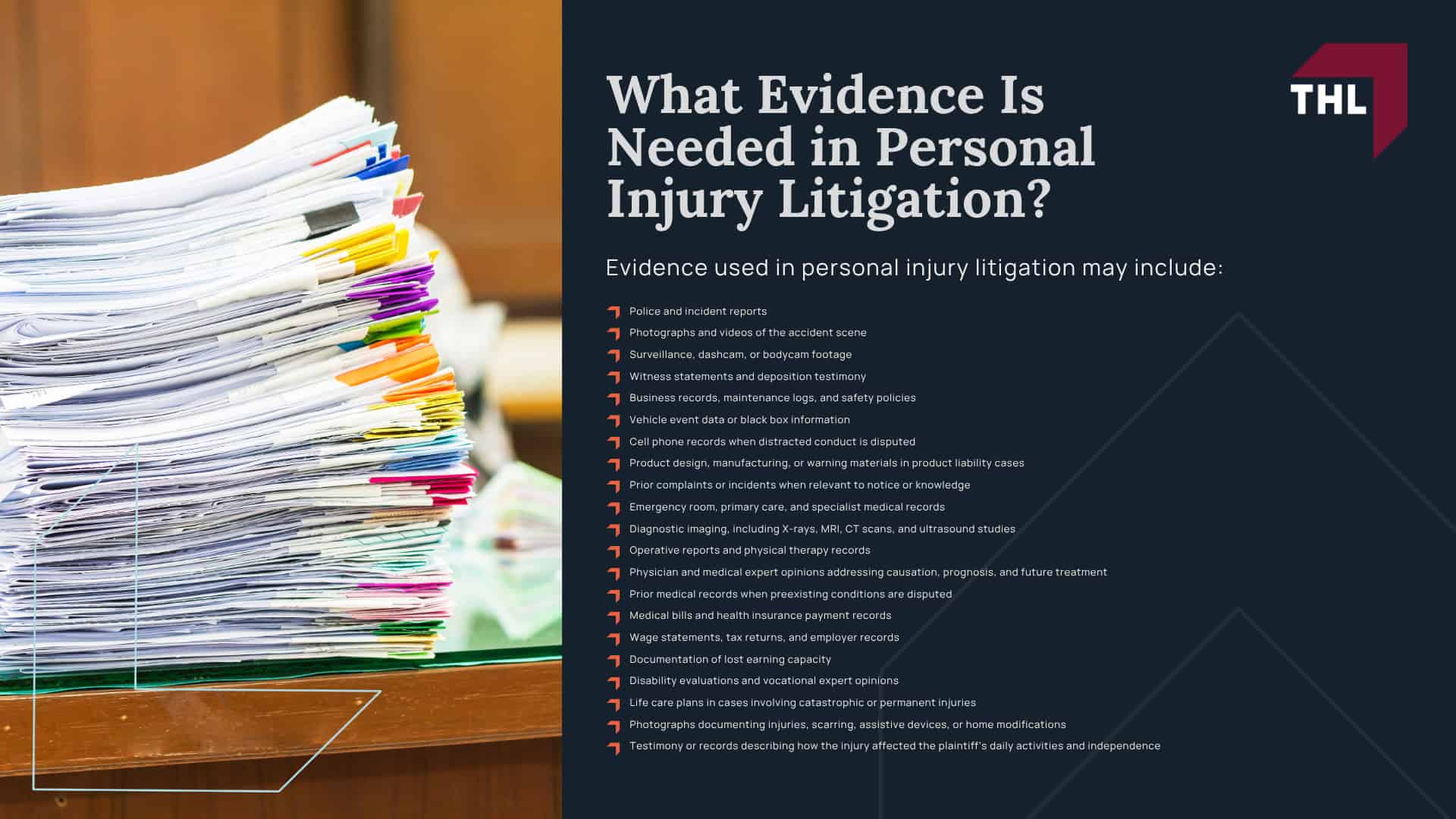
Evidence used in personal injury litigation may include:

  • Police and incident reports
  • Photographs and videos of the accident scene
  • Surveillance, dashcam, or bodycam footage
  • Witness statements and deposition testimony
  • Business records, maintenance logs, and safety policies
  • Vehicle event data or black box information
  • Cell phone records when distracted conduct is disputed
  • Product design, manufacturing, or warning materials in product liability cases
  • Prior complaints or incidents when relevant to notice or knowledge
  • Emergency room, primary care, and specialist medical records
  • Diagnostic imaging, including X-rays, MRI, CT scans, and ultrasound studies
  • Operative reports and physical therapy records
  • Physician and medical expert opinions addressing causation, prognosis, and future treatment
  • Prior medical records when preexisting conditions are disputed
  • Medical bills and health insurance payment records
  • Wage statements, tax returns, and employer records
  • Documentation of lost earning capacity
  • Disability evaluations and vocational expert opinions
  • Life care plans in cases involving catastrophic or permanent injuries
  • Photographs documenting injuries, scarring, assistive devices, or home modifications
  • Testimony or records describing how the injury affected the plaintiff’s daily activities and independence

No single category of evidence proves every personal injury case.

The record must support the specific issues in dispute, including who caused the incident, whether that conduct caused the claimed injury, and the extent of the resulting damages.

How Long Does a Personal Injury Lawsuit Take?

The timeline for a personal injury lawsuit can range from several months to several years.

The length of the case depends on the court, the number of parties involved, the severity of the injuries, disputed liability or causation, the amount of discovery required, expert testimony, motion practice, settlement negotiations, and whether the case proceeds to trial or appeal.

Civil cases generally move through filing, service, discovery, pretrial motions, settlement efforts, and trial if the parties do not reach an earlier resolution.

The process often begins before a lawsuit is filed.

During the initial consultation, a personal injury attorney may review the circumstances of the injury, available evidence, insurance information, medical treatment, and applicable filing deadlines.

If the attorney and client establish an attorney-client relationship, the law firm can investigate the claim, obtain records, communicate with insurers and other parties, and determine whether pre-suit negotiations are appropriate or litigation should begin.

Once a lawsuit is filed, the court typically establishes deadlines for discovery, expert disclosures, motions, pretrial proceedings, and other stages of the case.

Scheduling practices vary substantially among courts, and trial availability can affect the overall timeline.

What Does Litigation Mean in a Personal Injury Case; What Is the Difference Between a Personal Injury Claim and a Personal Injury Lawsuit; When Does a Personal Injury Claim Turn Into Litigation; What Is the Personal Injury Litigation Process; What Evidence Is Needed in Personal Injury Litigation; How Long Does a Personal Injury Lawsuit Take

A case may resolve through settlement at many points during litigation.

If settlement does not occur, additional time may be required for depositions, expert analysis, dispositive motions, mediation, pretrial preparation, trial, and any post-trial proceedings or appeal.

For that reason, no attorney can reliably predict the duration of a personal injury lawsuit without reviewing the specific facts, jurisdiction, court schedule, and disputes involved.

What Deadlines Apply in Personal Injury Litigation?

Personal injury litigation is governed by deadlines that can affect whether a claim may proceed and how the lawsuit process develops.

One of the most important is the statute of limitations, which generally sets the time available to file a lawsuit.

The applicable deadline depends on the jurisdiction, type of claim, defendant, and rules governing when the claim accrued.

Other deadlines arise after litigation begins.

Courts may impose schedules for serving defendants, completing discovery, disclosing expert witnesses, filing motions, participating in mediation, and preparing for trial.

Federal courts, for example, use scheduling orders to establish deadlines for discovery and other pretrial proceedings, although state and local procedures vary.

What Does Litigation Mean in a Personal Injury Case; What Is the Difference Between a Personal Injury Claim and a Personal Injury Lawsuit; When Does a Personal Injury Claim Turn Into Litigation; What Is the Personal Injury Litigation Process; What Evidence Is Needed in Personal Injury Litigation; How Long Does a Personal Injury Lawsuit Take; What Deadlines Apply in Personal Injury Litigation

Common deadlines in a personal injury lawsuit may include:

  • Statute of limitations. The deadline for commencing a legal action under the law governing the claim.
  • Government notice requirements. Claims involving a public entity or employee may require written notice before the ordinary lawsuit deadline.
  • Service deadlines. After filing, the plaintiff must complete service of process within the period required by the applicable procedural rules.
  • Discovery and expert deadlines. Courts establish dates for written discovery, depositions, document production, and expert disclosures.
  • Motion and pretrial deadlines. The parties may face specific deadlines for dispositive motions, evidentiary motions, witness lists, exhibits, and other trial materials.
  • Appeal deadlines. A party seeking review of a final judgment or appealable order must comply with the applicable appellate rules.

A missed deadline can result in dismissal, exclusion of evidence, discovery sanctions, or loss of appellate rights, depending on the rule involved.

Although many personal injury lawsuits settle before needing a trial, accepting a settlement offer does not eliminate the need to comply with applicable deadlines while the case remains pending.

What Damages Can Be Recovered in a Personal Injury Lawsuit?

Damages in a personal injury lawsuit compensate an injured person for losses caused by the defendant’s legally responsible conduct.

What Does Litigation Mean in a Personal Injury Case; What Is the Difference Between a Personal Injury Claim and a Personal Injury Lawsuit; When Does a Personal Injury Claim Turn Into Litigation; What Is the Personal Injury Litigation Process; What Evidence Is Needed in Personal Injury Litigation; How Long Does a Personal Injury Lawsuit Take; What Deadlines Apply in Personal Injury Litigation; What Damages Can Be Recovered in a Personal Injury Lawsuit

In most personal injury lawsuits, recoverable compensation depends on the nature and severity of the injury, available evidence, applicable state law, and any statutory limits on damages.

Economic Damages

Economic damages compensate measurable financial losses resulting from an injury.

Documentation may include medical bills, employment records, receipts, tax records, and expert analysis.

Economic damages may include:

  • Emergency treatment, hospitalization, surgery, and other medical care
  • Physical therapy, rehabilitation, medication, and medical equipment
  • Reasonably supported future medical expenses
  • Lost wages and other lost income
  • Reduced future earning capacity
  • Home health care or assistance
  • Necessary home or vehicle modifications
  • Transportation expenses related to treatment
  • Property damage when recoverable as part of the same claim

Non-Economic Damages

Non-economic damages compensate losses that do not have a fixed financial value.

Depending on the jurisdiction and evidence, these damages may address the physical and psychological effects of an injury.

Non-economic damages may include:

  • Pain and suffering
  • Emotional distress and mental anguish
  • Loss of enjoyment of life
  • Physical impairment
  • Disfigurement or scarring

Certain family members may also have separate claims for loss of consortium or similar derivative damages where recognized by applicable law.

Punitive Damages

Punitive damages are different from compensatory damages.

Rather than compensating the plaintiff for medical expenses, lost wages, emotional distress, or other losses, punitive damages are intended to punish and deter particularly wrongful conduct.

They are available only when the evidence satisfies the heightened legal standard imposed by the applicable jurisdiction and may be subject to statutory or constitutional limitations.

The types and amount of damages available in a personal injury case depend on the governing law and the evidence supporting each claimed loss.

TorHoerman Law: Speak With a Personal Injury Attorney

At TorHoerman Law, we represent people whose personal injury claims require formal investigation, negotiation, or litigation.

Our attorneys review the facts of the incident, evaluate available evidence, identify potentially responsible parties, document medical and financial losses, and determine whether filing a lawsuit is appropriate under the circumstances.

When litigation becomes necessary, we handle the procedural demands of the case, including pleadings, discovery, depositions, expert development, motion practice, mediation, settlement negotiations, and trial preparation.

Our attorneys work to build each claim around the evidence and the damages supported by applicable law.

What Does Litigation Mean in a Personal Injury Case; What Is the Difference Between a Personal Injury Claim and a Personal Injury Lawsuit; When Does a Personal Injury Claim Turn Into Litigation; What Is the Personal Injury Litigation Process; What Evidence Is Needed in Personal Injury Litigation; How Long Does a Personal Injury Lawsuit Take; What Deadlines Apply in Personal Injury Litigation; What Damages Can Be Recovered in a Personal Injury Lawsuit; TorHoerman Law_ Speak With a Personal Injury Attorney

Contact TorHoerman Law today for a free consultation about your personal injury claim, or use the chat feature on this page to start a case review.

Qualifying cases are handled on a contingency fee basis, which means attorney’s fees are not owed unless we recover compensation for you.

Frequently Asked Questions

Written By:
Picture of Tor Hoerman

Tor Hoerman

Owner & Attorney - TorHoerman Law

Do You
Have A Case?

Here, at TorHoerman Law, we’re committed to helping victims get the justice they deserve.

Since 2009, we have successfully collected over $4 Billion in verdicts and settlements on behalf of injured individuals.

Would you like our help?

About TorHoerman Law

TorHoerman Law represents people whose lives have been disrupted by serious injuries, unsafe products, and negligence. Our attorneys handle individual personal injury cases as well as national mass tort lawsuits involving major corporations.

Founded in 2009, our legal team brings more than 100 years of combined experience handling serious injury and complex civil litigation.

Do you believe you’re entitled to compensation?

Use our Instant Case Evaluator to find out in as little as 60 seconds!

$20 Million
Toxic Tort Injury

In this case, we were able to successfully recover $20 Million for our client after they suffered a Toxic Tort Injury due to chemical exposure.

$103.8 Million
COX-2 Inhibitors Injury

In this case, we were able to successfully recover $103.8 Million for our client after they suffered a COX-2 Inhibitors Injury.

$4 Million
Traumatic Brain Injury

In this case, we were able to successfully recover $4 Million for our client after they suffered a Traumatic Brain Injury while at daycare.

$2.8 Million
Defective Heart Device

In this case, we were able to successfully recover $2.8 Million for our client after they suffered an injury due to a Defective Heart Device.

Guides & Resources
Do You
Have A Case?

Here, at TorHoerman Law, we’re committed to helping victims get the justice they deserve.

Since 2009, we have successfully collected over $4 Billion in verdicts and settlements on behalf of injured individuals.

Would you like our help?

Share

Related Guides

What Our Clients Have To Say