
Mistakes made after an injury can affect the evidence available to prove liability, medical causation, and damages.
After a car accident, fall caused by hazardous conditions, or another incident involving alleged negligence, insurance companies may examine medical records, prior injuries, witness statements, photographs, recorded statements, treatment history, and other evidence when evaluating the claim.
Medical treatment is one of the first areas that can become disputed.
Refusing immediate medical treatment or delaying medically appropriate care may leave an incomplete picture of when symptoms developed and give an insurer grounds to question whether the accident caused the claimed injuries.
There is no universal 24- to 72-hour legal deadline for seeking treatment, but injured people should obtain appropriate medical evaluation based on their symptoms and follow reasonable treatment recommendations.
Communication with an insurance company also requires care.
Many claimants speak with an adjuster before the extent of their injuries, future treatment, or financial losses is known.
An injured person should provide required information accurately but avoid speculation, unsupported estimates, or detailed recorded statements to the opposing insurer without understanding how the information may affect the claim.
When legal counsel is involved, an attorney can handle or advise on communications with the insurance carrier.
A quick settlement offer can also arrive before a complete diagnosis, future medical needs, or long-term limitations are reasonably understood.
Accepting a settlement typically requires signing a release that gives up the claims covered by the agreement, which can prevent the injured person from later seeking additional compensation for those released claims.
Settlement should therefore be evaluated based on the available medical evidence, expected future losses, applicable insurance coverage, and the scope of the proposed release rather than simply because it is the first offer presented.

Common errors that can affect a personal injury claim include:
Avoidable errors can make it more difficult to recover damages, particularly when the insurer already disputes causation, fault, or the extent of the injuries.
Careful documentation and early attention to important deadlines can preserve evidence during an already challenging time and provide a more complete record for evaluating the claim.
Injured people should seek medically appropriate care as soon as reasonably possible after an accident.
Injuries involving severe pain, loss of consciousness, breathing problems, uncontrolled bleeding, neurological symptoms, or other urgent concerns may require immediate medical attention.
Other injuries may not appear serious at first but can become more apparent in the hours or days that follow.
Medical records created soon after an accident can help document when symptoms began, what injuries were diagnosed, and what treatment was recommended.
When treatment is substantially delayed, an insurer or defense attorney may argue that the accident did not cause the claimed injury, that another event caused harm, or that the injury was less serious than alleged.
Medical causation is ultimately evaluated from the available evidence rather than treatment timing alone.

Relevant medical evidence may include:
Follow-up care is also important.
Missing appointments or disregarding reasonable treatment recommendations can create disputes over whether an injured person took appropriate steps to address the injury.
At the same time, treatment gaps may have legitimate explanations, including lack of insurance, transportation problems, scheduling delays, or mounting bills.
Those circumstances should be documented rather than left unexplained.
Medical treatment serves both a health and evidentiary purpose in a personal injury claim.
Records showing the nature of the injury, treatment received, and reasonably anticipated future care can help establish the damages attributable to the accident.
After an accident, an injured person should report what happened accurately without speculating about who was legally responsible.
Fault may depend on evidence that is not available at the scene, including photographs, video footage, witness statements, vehicle data, maintenance records, traffic laws, or other information developed during an investigation.
Statements about speed, visibility, distance, distraction, or responsibility can later become part of an insurance claim or lawsuit.
An injured person who is uncertain about a fact should avoid guessing or filling in details from memory.
A statement such as “I did not see the other vehicle” or “I may have been going too fast” can take on greater significance when insurers or defense attorneys evaluate comparative fault.

After an accident, focus on providing factual information needed for medical treatment, an accident report, and the exchange of required identifying and insurance information.
Avoid making conclusions about legal fault before the circumstances have been investigated.
The same principle applies when speaking with an insurance adjuster.
Statements should be accurate and limited to facts the injured person actually knows.
Questions that require estimates, assumptions, or conclusions about responsibility should not be answered through speculation.
An injured person should be cautious when speaking with an insurance adjuster, particularly when the adjuster represents the person or company accused of causing the injury.
The adjuster evaluates the claim on behalf of the insurance carrier and may ask about fault, prior injuries, medical treatment, work status, physical limitations, pain levels, and the circumstances of the accident.
Without legal representation, insurance adjusters may ask questions before the injured person fully understands the diagnosis, prognosis, or financial impact of the injury.
Answers given early in the claims process can later be compared with medical records, deposition testimony, photographs, social media activity, or other evidence.
An estimate or incomplete statement may create a dispute even when the injured person was attempting to answer honestly.
Recorded statements require particular caution.
A recorded statement is an audio or video interview that creates a permanent account of the injured person’s answers.

The adjuster may ask about:
The injured person should not guess, speculate, minimize symptoms, exaggerate limitations, or provide estimates presented as facts.
Statements about an unresolved diagnosis or future medical condition should also be made carefully because additional testing may later reveal injuries that were not yet known.
A recorded statement to the opposing insurance company should not be treated as a routine requirement without first understanding whether one must be provided and how it may be used.
Obligations can differ when the injured person is communicating with their own insurer under an applicable insurance policy.
When an attorney represents the injured person, counsel can determine what information should be provided, prepare the client for necessary statements, and communicate with the insurance carrier about disputed issues.
The goal is not to withhold relevant information, but to provide accurate information without creating avoidable inconsistencies or unsupported admissions.
Social media activity can become relevant evidence in a personal injury claim when posts, photographs, videos, comments, location data, or other content conflict with allegations about pain, disability, emotional distress, work limitations, or daily activities.
Insurers and defense attorneys may review publicly available content and, during litigation, may seek relevant social media material through the discovery process.
Privacy settings do not necessarily prevent relevant content from becoming discoverable.
Under federal discovery rules, electronically stored information may be subject to production when it is relevant and proportional to the needs of the case.

Common social media mistakes during a personal injury claim include:
Deleting existing posts can create a separate problem.
Federal Rule of Civil Procedure 37(e) addresses the loss of electronically stored information that should have been preserved in anticipation or conduct of litigation and permits courts to impose remedies in appropriate circumstances.
An injured person should generally avoid discussing the accident, injuries, treatment, or claim publicly while the matter remains unresolved.
Existing potentially relevant content should be preserved rather than deleted without legal advice.
Early offers are frequently made before the injured person knows the full diagnosis, future treatment needs, permanent impairment, wage loss, or long-term effect on daily life.
Once a release is signed, the claim is usually over.
A release is a legal agreement that gives up the right to pursue additional compensation.
Most personal injury settlement releases are final, even if symptoms worsen later or surgery becomes necessary.

Before evaluating settlement, the following should be known or reasonably estimated:
Failing to preserve evidence is one of the most common mistakes in personal injury claims.
Evidence can disappear quickly.
Vehicles are repaired, surveillance footage is overwritten, accident scenes change, defective products are discarded, witnesses become unavailable, and electronic data may be deleted in the ordinary course of business.

Important evidence to preserve may include:
Deadlines are critical because missing the statute of limitations can bar a personal injury lawsuit.
A statute of limitations is the legal deadline for filing a lawsuit.
If the lawsuit is filed too late, the defendant can ask the court to dismiss the case, even if the injury is severe and liability is clear.
Deadlines vary by state and claim type.
Car accident claims, premises liability claims, medical malpractice claims, product liability claims, wrongful death claims, claims against government entities, and claims involving minors may have different rules.
Some claims require early notice before a lawsuit can be filed.

Deadlines that may affect a personal injury claim include:
Yes, signing broad medical authorizations or settlement releases without review can harm a personal injury claim.
A medical authorization allows an insurer to obtain medical records.
Some authorizations are overly broad and may permit the insurer to search unrelated medical history, prior injuries, mental health treatment, prescriptions, or records that have little connection to the claim.
Insurers are entitled to evaluate relevant medical issues, but the scope matters.
The injured person should understand what records are being requested, which providers are covered, what time period is included, and whether the authorization can be used repeatedly.
A settlement release is even more consequential.
By signing a release, the injured person usually gives up the right to bring additional claims against the released parties.
Broad releases may also affect claims against parties not clearly identified in the settlement discussions.
Example: A person signs a release after accepting a small payment from one driver’s insurer.
The release language may also protect related businesses, employers, vehicle owners, or other insureds.
That can create problems if additional defendants are later identified.
Exaggerating or minimizing injuries can both create problems in a personal injury claim.
The injured person’s statements may be compared with medical records, diagnostic imaging, employment records, surveillance, social media activity, witness testimony, and other evidence developed during the claim or litigation.
Overstating symptoms or physical limitations can damage credibility and give the defense grounds to challenge other parts of the claim.
Minimizing pain, functional limitations, emotional distress, or the effect of the injury can create the opposite problem by making the documented damages appear less serious than they actually are.
Injured people should describe symptoms, limitations, and changes in daily function as accurately as possible.
Medical providers should also be informed when symptoms improve, worsen, or change so that the treatment record reflects the person’s actual condition over time.
Prior injuries do not automatically defeat a personal injury claim.
A defendant is generally responsible for harm caused by the accident, including aggravation of a pre-existing condition.
Aggravation means the accident made an existing condition worse or symptomatic.
The mistake is hiding prior injuries or failing to explain them accurately.
Insurers frequently obtain prior medical records and use inconsistencies to attack credibility.
A clear medical history helps distinguish old conditions from new trauma or worsened symptoms.
The steps taken after an accident can affect the medical, factual, and financial evidence available to support a personal injury claim.
Injured people should focus on obtaining appropriate care, preserving evidence, documenting losses, and avoiding statements or agreements that may create unnecessary disputes later.
Personal Injury Claim Checklist:
No single checklist applies identically to every personal injury case.
The appropriate steps depend on the type of accident, injuries involved, available evidence, responsible parties, and the law governing the claim.
A mistake does not always destroy a personal injury claim.
The legal impact depends on the type of mistake, the available evidence, the governing state law, and whether the mistake can be explained or corrected.
Some errors can be addressed through supplemental medical records, witness statements, expert opinions, amended responses, preservation letters, or litigation strategy.
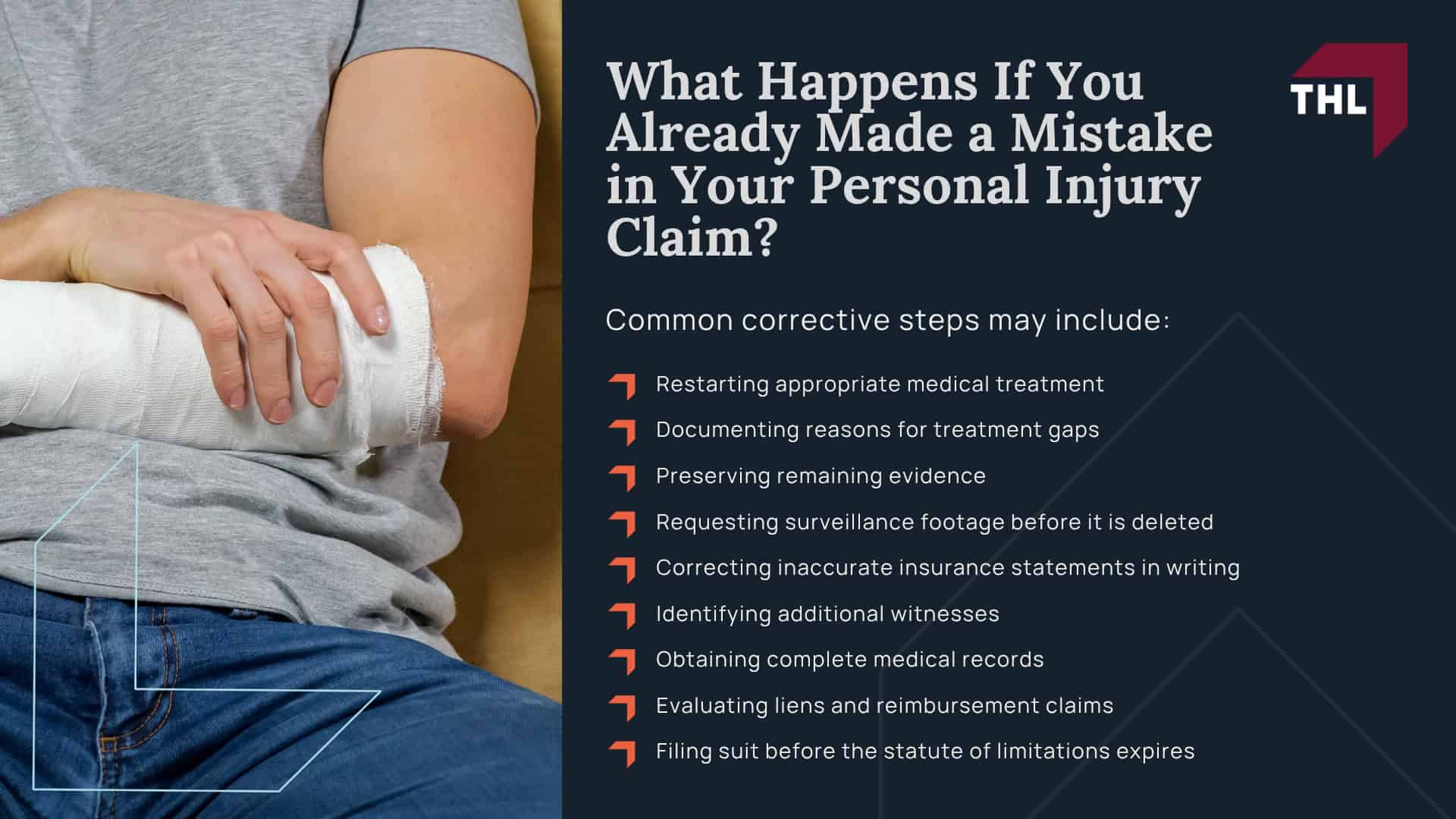
Common corrective steps may include:
At TorHoerman Law, we represent people whose personal injury claims involve disputed liability, significant injuries, insurance coverage questions, or other issues that require careful investigation and legal strategy.
Our attorneys review the available evidence, document medical and financial losses, communicate with insurance carriers, preserve relevant records, and determine whether litigation is necessary.
Legal representation can help level the playing field when an insurance company has adjusters, investigators, and defense attorneys evaluating the claim from the outset.
Once an attorney-client relationship is established, we can handle communications with insurers, address disputed issues, evaluate settlement offers, and prepare the case for litigation or trial when appropriate.

Contact TorHoerman Law today for a free consultation about your personal injury claim, or use the chat feature on this page to start a case review.
Qualifying cases are handled on a contingency-fee basis, so attorney’s fees are not owed unless we recover compensation for you.