Active Litigation
Nitrous Oxide Lawsuit Facts
TorHoerman Law is actively accepting claims for the Nitrous Oxide Lawsuit.

Active Litigation
TorHoerman Law is actively accepting claims for the Nitrous Oxide Lawsuit.
An Exotic Whip nitrous oxide lawsuit may allege that companies involved in manufacturing or selling the brand’s cylinders failed to adequately warn about injuries associated with recreational inhalation.
ExoticWhip advertises large nitrous oxide canisters for culinary use, while its safety manual expressly warns against inhaling the gas.
Ramdon Corporation, which is associated with the brand, has been named in U.S. product liability and wrongful death litigation involving alleged ExoticWhip use.
We are reviewing potential claims involving diagnosed neurological injuries, oxygen deprivation, blood clots, and other serious harm after use of ExoticWhip products.
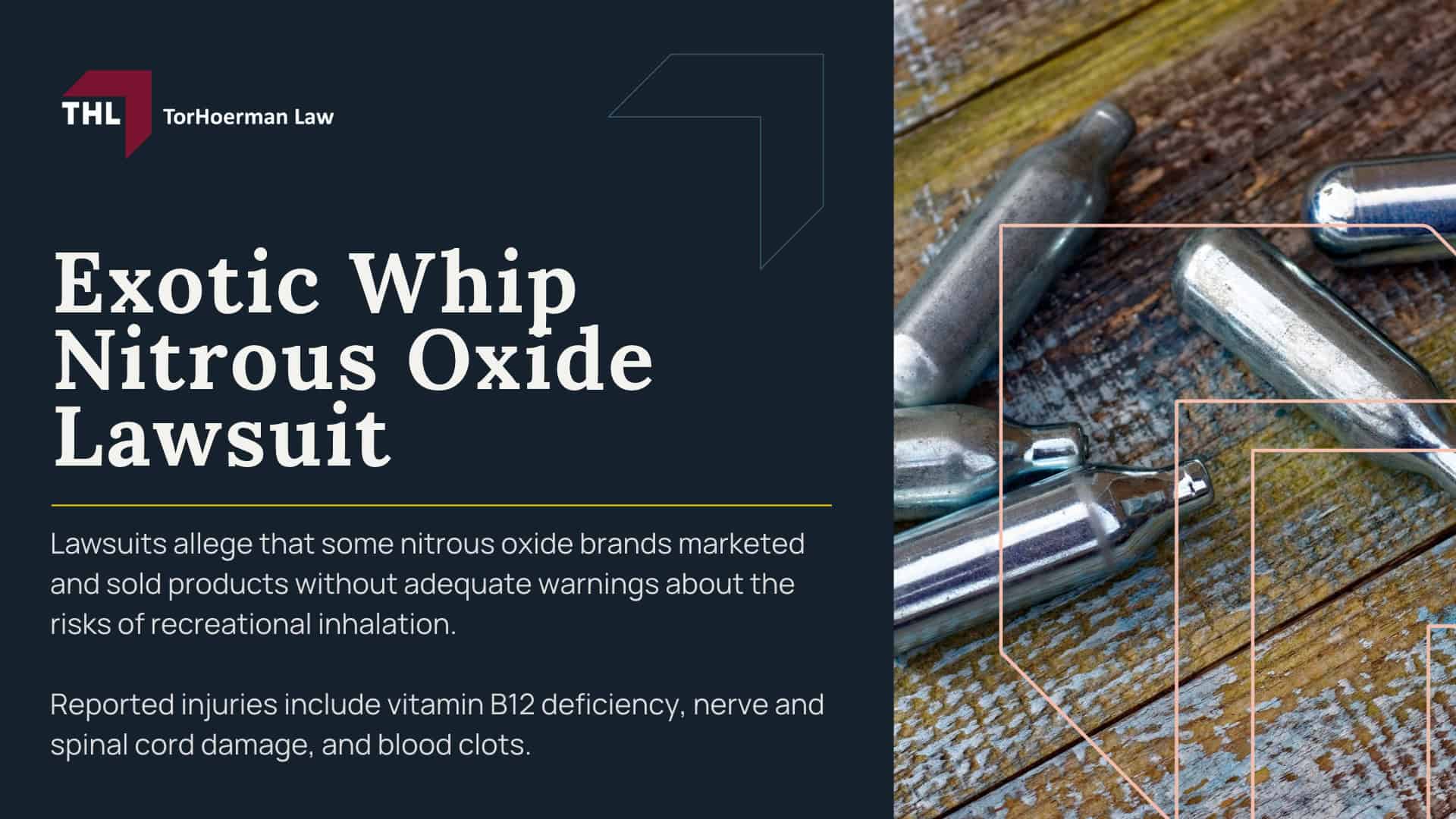
ExoticWhip’s official catalog lists cylinders containing 670, 1,350, and 2,000 grams of nitrous oxide gas for whipped cream and other food preparation.
The company promotes wholesale distribution for food service businesses, yet ExoticWhip cylinders have appeared in smoke shops and convenience stores.
It also warns users not to inhale the gas and acknowledges the risk of suffocation and cold burns in its cylinder manual.
The FDA added ExoticWhip to its list of brands in a June 2025 warning about nitrous oxide misuse involving canisters, tanks, or chargers.
U.S. lawsuits involving the brand include product liability allegations about foreseeable recreational inhalation and a separate allegation that a driver inhaled ExoticWhip before a fatal crash.
Those allegations do not establish that ExoticWhip caused any particular injury or that its published safety instructions were absent from a product someone purchased.
Our attorneys assess the specific cylinder, its warnings, the seller, the circumstances of use, and the medical or accident evidence through our broader nitrous oxide lawsuit practice.
Contact us for a free consultation or use the chat feature to discuss a potential Exotic Whip claim.
ExoticWhip markets nitrous oxide as a propellant for whipped cream, foams, cocktails, and other culinary preparations.
Its official cylinder catalog distinguishes current standard products from new designs listed for Europe only.
The standard cylinder sizes advertised by ExoticWhip include:
ExoticWhip’s product pages describe these sizes as food preparation products and offer wholesale quotations rather than direct consumer checkout.
The site also promotes cream dispensers and pressure regulators, and its distributor page invites food service businesses to apply to sell the brand.
ExoticWhip’s website states that access is intended for registered food service businesses.
That policy does not resolve how a particular cylinder reached a local retailer or who sold it to the person who used it.
The FDA reports that nitrous oxide canisters marketed for culinary use are sold online and through smoke and vape shops and gas stations.
In San Francisco, ExoticWhip cylinders were found at local smoke shops and convenience stores.
Wisconsin city officials documented the sale of a flavored ExoticWhip cylinder at a gas station.
ExoticWhip told CBS News that it sells to verified food and beverage businesses, requires commitments from distributors against inappropriate resale, and is concerned about counterfeit products.
The presence of branded cylinders in these stores may bear on allegations that recreational inhalation was foreseeable, even though the stores’ authorization and the products’ authenticity must be established separately.
Purchase records and the physical container may identify the seller, the distribution path, and any warnings available to a buyer.
ExoticWhip says its newer bottles have a unique QR code, laser engraving, and a barcode to help identify genuine products.
That matters in an injury claim because a photograph of a branded container may not resolve whether it was genuine, which version was used, or which company supplied it.
Preserving the original cylinder, QR code, lot information, and packaging can help answer those questions.
The company’s cylinder user manual says not to inhale the gas and warns that high concentrations can displace oxygen and cause rapid suffocation.
It also warns about pressure hazards and frostbite from contact with the liquid.
ExoticWhip has separately described recreational inhalation as dangerous and says its chargers are intended for culinary use.
These published statements should be considered when evaluating a failure-to-warn claim, along with the label and instructions that accompanied the particular product at the time of purchase.
A lawsuit may still dispute whether the warnings adequately addressed risks from foreseeable repeated inhalation, including vitamin B12 disruption and nerve damage.
Ramdon Corporation is identified as the owner of the EXOTICWHIP mark in U.S. trademark records.
A 2024 announcement by Ramdon Ltd. describes that entity as the manufacturer of Exotic Whip and FastGas and promotes the brands at the Champs Trade Show in Las Vegas.
The announcement presents culinary uses for its large cylinders and refers to U.S. warehousing and distribution.
The relationship between Ramdon Corporation and Ramdon Ltd., and the roles of any distributor or retailer in a particular sale, require confirmation from product and transaction records.
In Maldonado v. Galaxy Gas LLC et al., filed in Los Angeles County Superior Court on April 30, 2026, the plaintiff named Ramdon Corporation doing business as Exotic Whip among numerous nitrous oxide defendants.
The filed complaint asserts product design and failure-to-warn claims and alleges that nitrous oxide was marketed and distributed through smoke shops and similar outlets where recreational inhalation was foreseeable.
The case involves multiple brands and businesses, so its filing does not determine which company or product caused an alleged injury.
The California Judicial Council has listed the case among the Nitrous Oxide Inhalation Cases, JCCP No. 5506, for coordinated proceedings.
Coordination is a procedural step, not a finding that any defendant is liable.
In a separate lawsuit filed in August 2026, Echo Ryan, the mother of Anisha Gutshall, alleged that a driver inhaled ExoticWhip nitrous oxide before a crash that killed her daughter.
The reported complaint names Ramdon Corporation and alleges that companies in the product’s distribution chain made large cylinders available despite foreseeable inhalation.
Those allegations remain unproven, and the driver’s criminal case did not establish that nitrous oxide was involved in the collision.
This is a claim about an alleged third-party crash, which presents different evidence and legal questions from a claim by someone injured after personally inhaling nitrous oxide.
The FDA’s public health advisory warns against inhaling nitrous oxide products of any size or flavor and added ExoticWhip to its named brands in June 2025.
The agency lists possible health problems including asphyxiation, blood clots, frostbite, vitamin B12 deficiency, psychiatric symptoms, spinal cord damage, and death.
The U.S. warning addresses the risks of recreational inhalation across multiple brands; it is not a U.S. recall of ExoticWhip cylinders.
In Canada, a May 2026 Health Canada recall identified Exotic Whip products in Original, Strawberry, Coconut, Mexican Mango, Lemonade, and Saturn varieties that were sold for inhalation without market authorization.
The listed recalling company was a Canadian retailer, Smoke Arsenal, and the action concerned products distributed in Canada.
It should not be taken to mean that every ExoticWhip cylinder was recalled or that Health Canada made a finding about a particular U.S. purchase.
Nitrous oxide is a colorless gas sometimes called laughing gas; it is also a whipping agent used with whipped cream dispensers, and small whipped cream chargers are sometimes called whippets when misused as an inhalant.
Medical administration for sedation or pain relief occurs under professional supervision, while recreational nitrous oxide use may involve repeated inhalation without adequate oxygen.
Some people release gas from a large cylinder into a balloon and inhale it.
These nitrous oxide effects can fade within minutes, but repeated inhalation from the same cylinder can produce cumulative harm.
Frequent nitrous oxide use can inactivate vitamin B12 in the body and contribute to peripheral neuropathy or spinal cord injury.
Symptoms of nitrous oxide toxicity can include tingling, numbness, weakness, poor balance, and trouble walking; severe injuries may involve paralysis.
A clinical review of nitrous oxide toxicity explains that serum vitamin B12 can appear normal despite functional deficiency and that homocysteine, methylmalonic acid, MRI, and nerve studies may assist diagnosis.
Treatment generally involves stopping exposure and replacing vitamin B12, often through injections when neurological injury is suspected; some patients also need physical or occupational therapy.
When a person struggles to stop using nitrous oxide, medical professionals may recommend substance use treatment or mental health support to help prevent relapse.
The Substance Abuse and Mental Health Services Administration’s treatment locator can help families find qualified providers.
Recovery varies, and medical care should not be delayed when neurological symptoms appear.
Published clinical cases of heavy nitrous oxide use have reported elevated homocysteine and serious blood clots, including pulmonary embolism.
Inhaling the gas without enough oxygen can cause hypoxia, loss of consciousness, falls, asphyxiation, or brain damage.
Gas discharged from a pressurized cylinder can cause cold burns, while the FDA also identifies hallucinations, paranoia, and depression among reported psychiatric symptoms.
Anxiety or other mood disturbances after nitrous oxide use may warrant clinical assessment alongside neurological and respiratory symptoms.
An injury assessment must consider the person’s medical history, other exposures, and the circumstances of use rather than assume that a specific cylinder caused every later symptom.
People with new weakness, walking difficulty, chest pain, breathing trouble, or confusion after inhaling nitrous oxide should seek medical attention promptly and disclose their use.
ExoticWhip’s product authentication features make the physical cylinder particularly useful for identifying the brand and version involved.
The person’s medical and purchase history can help determine whether the alleged injury is consistent with the timing and amount of use.
Evidence may include:
Other personal injury evidence may help establish who sold the product, what warnings were available, and how the injury affected the person.
The exact facts needed will differ between a neurological injury claim and a claim arising from a collision or death.
A claim may involve allegations against a brand owner, manufacturer, distributor, retailer, or online seller, depending on its role in the sale and the law governing the case.
The presence of a warning in a company manual does not establish that every buyer received it, and a lawsuit must address the warnings actually supplied with the product at issue.
An injured person also needs evidence connecting the alleged legal wrong and the particular product to the harm claimed.
If a claim succeeds, damages may include medical expenses, rehabilitation, lost income, reduced earning capacity, pain, and lasting disability.
An eligible family member or estate representative may be able to pursue a wrongful death claim when the evidence and state law support it.
Deadlines depend on the applicable state and type of claim, and no outcome or settlement amount is guaranteed.
We review serious injuries and deaths allegedly connected to ExoticWhip nitrous oxide products.
Our attorneys can assess the cylinder, warnings, seller, medical history, and other evidence to determine what claims may be available.
Contact TorHoerman Law for a free consultation or use the chat feature on this page.
Yes.
Ramdon Corporation doing business as Exotic Whip was named among multiple defendants in a California product liability lawsuit filed in 2026.
A separate wrongful death complaint alleges an ExoticWhip product was involved in a fatal California crash, but the allegation that nitrous oxide contributed to that crash has not been established.
Yes.
Its published cylinder manual instructs users not to inhale the gas and warns about oxygen displacement, rapid suffocation, and frostbite.
The warnings that accompanied a particular product, and their adequacy under applicable law, require individual review.
Health Canada listed certain Exotic Whip chargers in a May 2026 recall involving products sold for inhalation without Canadian market authorization.
The FDA separately named ExoticWhip in a U.S. warning against inhaling nitrous oxide products but did not announce a U.S. recall of the brand.
The official catalog lists standard cylinders containing 670, 1,350, and 2,000 grams of nitrous oxide.
The brand also lists some designs specifically for Europe, so the size and version of a U.S. product should be verified from its packaging.
Keep the cylinder, packaging, purchase records, and any QR code or barcode information.
ExoticWhip provides a verification process for newer products, but the outcome of a product authentication check should be considered with the full purchase and supply-chain evidence.
Possibly.
Use of other brands can complicate proof of exposure and responsibility, but it does not automatically bar a claim.
A complete account of the products used, dates, sellers, and medical findings helps evaluate the case.

Tor Hoerman has represented injured individuals for more than 30 years, with experience spanning individual personal injury cases and nationwide mass tort litigation. His work includes car accidents, catastrophic injuries, product liability claims, and other serious injury cases. Tor has served in court-appointed leadership roles in national litigation and tried cases involving major corporate defendants.
TorHoerman Law’s legal content is researched and written by our editorial team and attorneys for legal accuracy, clarity, and relevance. We rely on statutes, court records, government publications, medical research, and other authoritative sources when applicable. This page provides general legal information and does not constitute legal advice.
TorHoerman Law reviews its legal content for factual accuracy, current information, and relevant legal context before publication and as material developments occur. This article is provided for general informational purposes and does not constitute legal advice. For guidance about a specific case, contact TorHoerman Law.
You can learn more about this topic by visiting any of our Nitrous Oxide Lawsuit pages listed below:
A serious injury can change your life.

TorHoerman Law represents people whose lives have been disrupted by serious injuries, unsafe products, and negligence. Our attorneys handle individual personal injury cases as well as national mass tort lawsuits involving major corporations.
Founded in 2009, our legal team brings more than 100 years of combined experience handling serious injury and complex civil litigation.
Do you believe you’re entitled to compensation?
Use our Instant Case Evaluator to find out in as little as 60 seconds!

In this case, we obtained a verdict of $495 Million for our client’s child who was diagnosed with Necrotizing Enterocolitis after consuming baby formula manufactured by Abbott Laboratories.

In this case, we were able to successfully recover $20 Million for our client after they suffered a Toxic Tort Injury due to chemical exposure.

In this case, we were able to successfully recover $103.8 Million for our client after they suffered a COX-2 Inhibitors Injury.

In this case, we were able to successfully recover $4 Million for our client after they suffered a Traumatic Brain Injury while at daycare.

In this case, we were able to successfully recover $2.8 Million for our client after they suffered an injury due to a Defective Heart Device.
A serious injury can change your life.