Active Litigation
Nitrous Oxide Lawsuit Facts
TorHoerman Law is actively accepting claims for the Nitrous Oxide Lawsuit.

Active Litigation
TorHoerman Law is actively accepting claims for the Nitrous Oxide Lawsuit.
A Whip-It! nitrous oxide lawsuit may allege that United Brands or a seller failed to warn about foreseeable recreational inhalation or negligently supplied chargers for that use.
California prosecutors obtained a $50,000 civil judgment against United Brands in 2020 over age verification and warning requirements for online sales.
A Missouri jury returned a $745 million wrongful death verdict involving Whip-It! in 2023, and the parties reportedly settled the case in April 2024.
The FDA has named Whip-it! in its warning against nitrous oxide inhalation, while Health Canada has recalled specific Whip-it! chargers sold for inhalation in Canada.
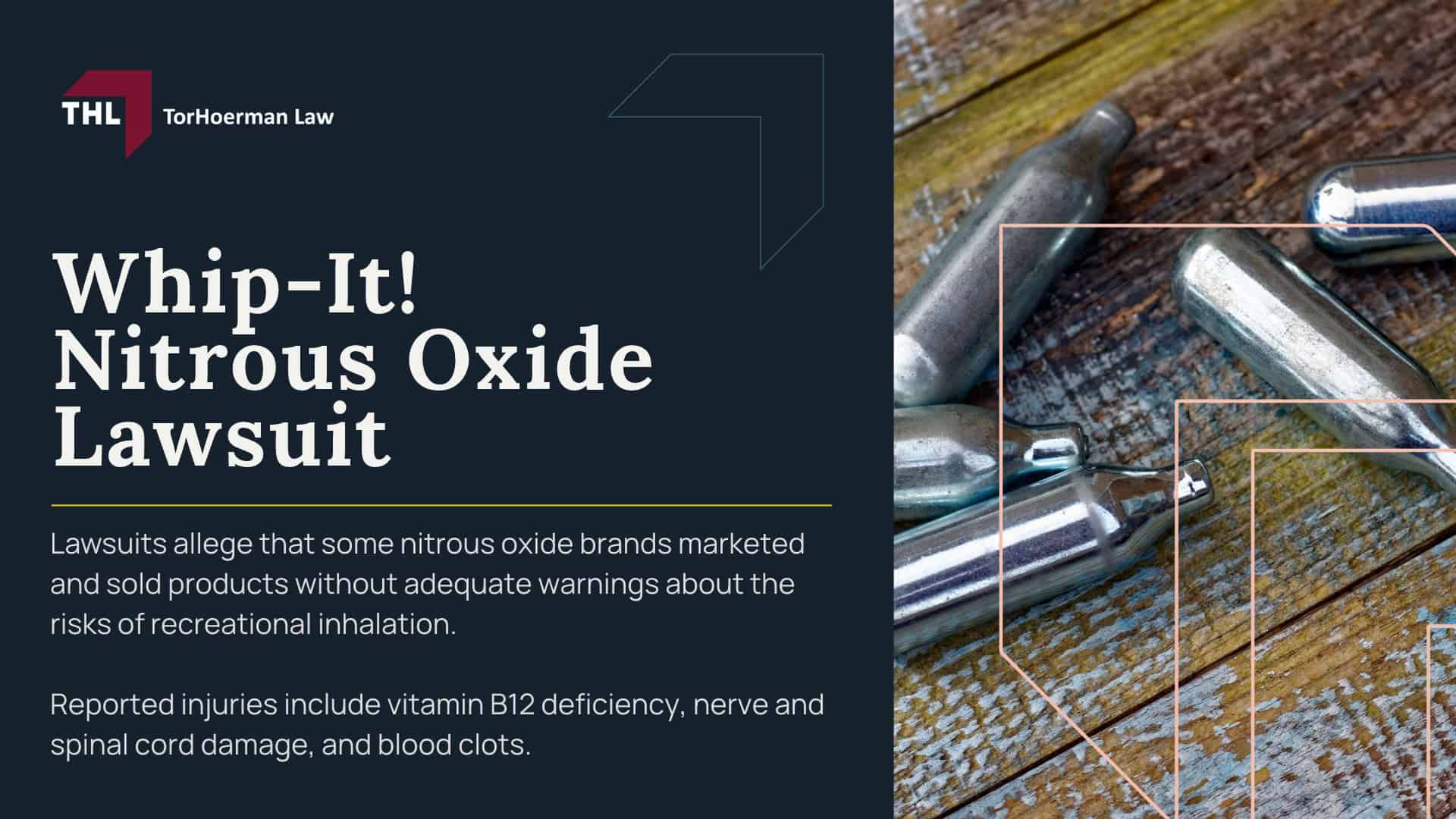
United Brands does business under the Whip-It! name and sells nitrous oxide cream chargers for food preparation.
Its catalog includes Original and Elite chargers, along with products that contain other gases.
People often use “whippets” or “whip-its” as general terms for recreational nitrous oxide, so packaging matters when identifying the brand involved in an injury.
United Brands’ current website warns against inhaling its nitrous oxide chargers, but a claim involving an earlier purchase requires the warnings available when that product was sold.
Repeated nitrous oxide misuse can cause nerve damage and spinal cord injury, while oxygen deprivation or cold burns can occur during a single episode.
Our attorneys assess the product, seller, warnings, and medical records when reviewing a potential nitrous oxide lawsuit.
Contact TorHoerman Law for a free consultation or use our chat feature to discuss a possible claim.
The Whip-It! Original cream charger is a steel cartridge containing up to eight grams of nitrous oxide for use with a whipped cream dispenser.
The company also sells Elite aluminum chargers and Select cream chargers in multipacks and bulk cases.
Whip-It! sells nitrogen coffee chargers as well, so a Whip-It! label alone does not identify which gas a person used.
The slang “whippets” and “whip-its” can refer to nitrous oxide use without identifying a Whip-It! branded cartridge.
Product packaging, cartridge markings, and purchase records can establish whether an injured person used the brand and which company sold it.
The current Original charger listing restricts sales to adults, says the product is for food and beverage preparation, and warns that inhalation can cause addiction, central nervous system damage, paralysis, or death.
Its label also carries a reproductive harm warning because California lists nitrous oxide under Proposition 65.
That warning concerns birth defects or other reproductive harm; the 2020 California enforcement action concerned separate age verification and safety disclosures.
The San Diego County District Attorney announced a $50,000 stipulated civil judgment against United Brands on October 21, 2020.
Prosecutors from San Diego and San Mateo counties alleged that the company’s online store sold nitrous oxide cartridges without checking whether purchasers were adults or providing health and safety warnings required by California law.
The district attorney said investigators had also identified United Brands as a distributor of nitrous oxide to San Diego smoke shops.
The judgment, entered October 19, 2020, required United Brands to comply with age verification and disclosure rules and pay $50,000 in civil penalties.
United Brands cooperated in resolving the action, according to the district attorney.
For an earlier purchase, the original label and purchase date help establish which warnings were available.
On September 8, 2023, a St. Louis County jury returned a $745 million wrongful death verdict after a driver who had inhaled Whip-It! nitrous oxide struck and killed Marissa Politte outside a Ballwin, Missouri, urgent care facility.
The jury allocated 70% of fault to United Brands, 20% to the local smoke shop Coughing Cardinal, and 10% to the driver.
The case involved the companies’ sales of nitrous oxide for foreseeable recreational inhalation and the driver’s decision to use the product and drive.
United Brands disputed responsibility for the driver’s conduct.
It was reported that the parties settled in April 2024 for substantially less than the jury verdict.
The $745 million figure is the jury’s award, not the amount the family recovered through the later settlement.
Politte was a pedestrian killed in a crash, rather than a person claiming neurological injury from inhaling nitrous oxide.
Her case addressed a particular distributor, retailer, sale, and fatal incident; an injury claim involving a different purchase requires its own evidence.
The FDA warning addresses nitrous oxide inhalation in the United States, while Canadian recalls name specific Whip-it! chargers sold for inhalation without market authorization.
The FDA named Whip-it! in its March 14, 2025 advisory warning against recreational inhalation from nitrous oxide canisters, chargers, and tanks.
The agency lists health risks including vitamin B12 deficiency, numbness, limb weakness, blood clots, frostbite, paralysis, psychiatric symptoms, asphyxiation, and death.
It identifies online retailers, smoke and vape shops, and gas stations as outlets for nitrous oxide products generally.
The FDA advisory did not recall Whip-It! chargers.
A Health Canada recall dated November 5, 2025 names Whip-it! NITRO Whip Cream Chargers, N2O Cream Chargers, and N2O Elite Aluminum Cream Chargers.
It identifies KDK Distributors as the company involved and says the affected products were sold for inhalation without Canadian market authorization.
A separate April 2026 Canadian recall lists a Whip-it! N2O Cream Charger.
The Canadian notices concern products sold in Canada and do not identify the seller or labeling of a particular U.S. purchase.
Nitrous oxide, also called laughing gas, is administered under supervision for pain relief during some medical and dental procedures.
People who inhale nitrous oxide recreationally face risks of oxygen deprivation and neurological injury.
Repeated exposure can inactivate vitamin B12 and injure nerve fibers, causing numbness, muscle weakness, difficulty walking, and peripheral neuropathy.
Some people develop spinal cord damage, including subacute combined degeneration.
This injury can impair mobility or cause partial paralysis.
A clinical review of nitrous oxide toxicity notes that serum vitamin B12 may appear normal despite functional deficiency; clinicians may also consider homocysteine, methylmalonic acid, spinal MRI, and nerve conduction studies.
Treatment generally involves stopping nitrous oxide use, vitamin B12 replacement, and rehabilitation when needed.
Some people have permanent neurological damage despite treatment.
Some people also need care for nitrous oxide addiction.
Inhalation without enough oxygen can cause loss of consciousness or brain injury, and the rapid release of pressurized gas can cause cold burns.
Heavy use has also been associated with deep vein thrombosis and pulmonary embolism, though a patient’s other clotting risks require medical assessment.
New weakness, trouble walking, chest pain, or shortness of breath after inhalation warrants prompt medical care and disclosure of the exposure to the treating clinician.
We assess which Whip-It! charger was used, who sold it, and the warnings available at the time of sale.
Medical records and exposure history help establish the cause and severity of an injury.
Relevant evidence may include:
Whip-It! lawsuits may allege inadequate inhalation warnings or negligent distribution through outlets where recreational use was foreseeable.
Medical findings can document an injury from nitrous oxide exposure, while packaging and purchase records identify whether the product was Whip-It!.
A person with a documented injury after using Whip-It! may have a personal injury claim if the evidence supports legal responsibility by a manufacturer, distributor, or seller.
Eligible relatives or estate representatives may bring a wrongful death claim when a death and the company’s alleged conduct are legally connected.
Recoverable damages may include medical expenses, rehabilitation, lost income, future care, physical pain, and other proven losses under applicable state law.
There is no standard Whip-It! settlement amount for neurological injuries, and the Missouri crash verdict does not establish one.
Filing deadlines depend on the state and the type of claim.
We are reviewing serious injuries and deaths allegedly connected to recreational inhalation of Whip-It! nitrous oxide chargers.
Our personal injury attorneys assess the packaging, purchase history, warnings, medical records, and the role of each business involved in the sale.
Contact TorHoerman Law for a free consultation or use our chat feature.
No.
“Whippets” is a general term for recreational nitrous oxide use, while Whip-It! is a brand sold by United Brands.
Packaging and purchase records can show whether a person used a Whip-It! product.
The FDA named Whip-it! in a warning against inhaling nitrous oxide, but the advisory was not a U.S. product recall.
Health Canada separately recalled specific Whip-it! chargers sold for inhalation without Canadian market authorization.
Missouri Lawyers Media reported that the parties settled the Politte wrongful death case in April 2024 for substantially less than the jury’s 2023 award.
The verdict involved a fatal crash caused by an impaired driver and does not determine the value of an inhalation injury claim.
The company currently warns against inhalation and describes serious neurological risks on its product listings.
An earlier claim depends on the warnings and sales practices in place when the product was purchased.

Tor Hoerman has represented injured individuals for more than 30 years, with experience spanning individual personal injury cases and nationwide mass tort litigation. His work includes car accidents, catastrophic injuries, product liability claims, and other serious injury cases. Tor has served in court-appointed leadership roles in national litigation and tried cases involving major corporate defendants.
TorHoerman Law’s legal content is researched and written by our editorial team and attorneys for legal accuracy, clarity, and relevance. We rely on statutes, court records, government publications, medical research, and other authoritative sources when applicable. This page provides general legal information and does not constitute legal advice.
TorHoerman Law reviews its legal content for factual accuracy, current information, and relevant legal context before publication and as material developments occur. This article is provided for general informational purposes and does not constitute legal advice. For guidance about a specific case, contact TorHoerman Law.
You can learn more about this topic by visiting any of our Nitrous Oxide Lawsuit pages listed below:
A serious injury can change your life.

TorHoerman Law represents people whose lives have been disrupted by serious injuries, unsafe products, and negligence. Our attorneys handle individual personal injury cases as well as national mass tort lawsuits involving major corporations.
Founded in 2009, our legal team brings more than 100 years of combined experience handling serious injury and complex civil litigation.
Do you believe you’re entitled to compensation?
Use our Instant Case Evaluator to find out in as little as 60 seconds!

In this case, we obtained a verdict of $495 Million for our client’s child who was diagnosed with Necrotizing Enterocolitis after consuming baby formula manufactured by Abbott Laboratories.

In this case, we were able to successfully recover $20 Million for our client after they suffered a Toxic Tort Injury due to chemical exposure.

In this case, we were able to successfully recover $103.8 Million for our client after they suffered a COX-2 Inhibitors Injury.

In this case, we were able to successfully recover $4 Million for our client after they suffered a Traumatic Brain Injury while at daycare.

In this case, we were able to successfully recover $2.8 Million for our client after they suffered an injury due to a Defective Heart Device.
A serious injury can change your life.