Active Litigation
Nitrous Oxide Lawsuit Facts
TorHoerman Law is actively accepting claims for the Nitrous Oxide Lawsuit.

Active Litigation
TorHoerman Law is actively accepting claims for the Nitrous Oxide Lawsuit.
A Fast Gas nitrous oxide lawsuit may allege that companies involved in selling FastGas cylinders failed to adequately warn about injuries from foreseeable recreational nitrous oxide use.
FastGas advertises large nitrous oxide cream chargers for culinary use and says its wholesale sales are limited to registered businesses.
Its user manual instructs people not to inhale the gas and warns of rapid suffocation and cold burns.
Ramdon Corp. doing business as FastGas has been named in a U.S. complaint involving alleged injuries from nitrous oxide products, and we are reviewing potential claims involving people who can identify FastGas use and a serious injury.
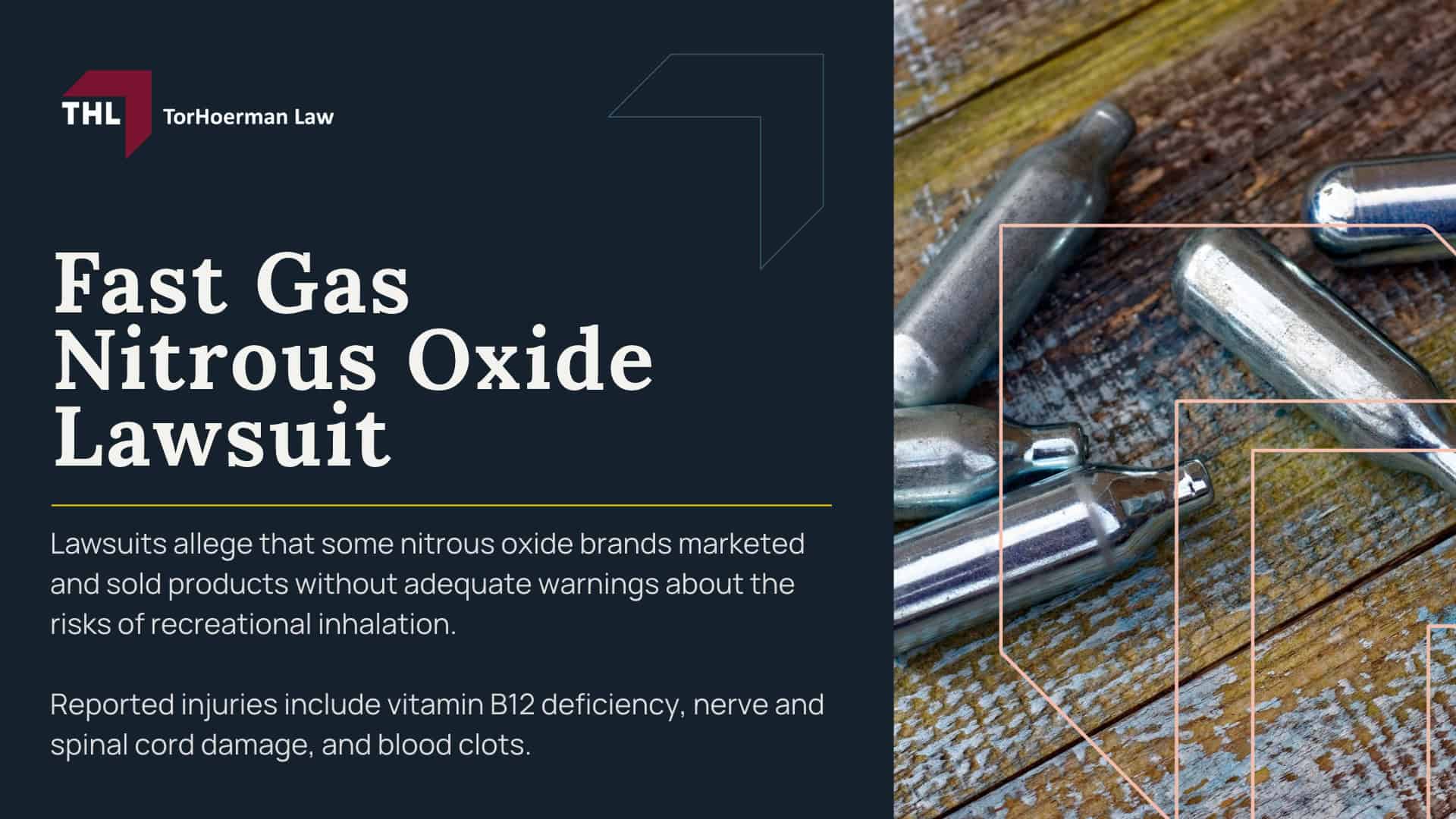
FastGas markets pressurized nitrous oxide gas cylinders for whipped cream, cocktail foams, sauces, and other food preparation.
Its website advertises 670-gram, 1,350-gram, and 2,000-gram sizes, although its current online product catalog displays the 670-gram and 2,000-gram cylinders.
The brand promotes distribution to food service businesses and supplies pressure regulators, siphons, and creamers for culinary use.
The FDA specifically added FastGas to its nitrous oxide inhalation advisory in June 2025.
A Washington product liability complaint names Ramdon Corp. doing business as FastGas among numerous nitrous oxide companies, alleging inadequate warnings and foreseeable recreational use.
Being named in that case does not establish that FastGas caused a particular plaintiff’s injury or that the brand’s published warnings were missing from a specific cylinder.
Our attorneys assess the product, seller, warnings, purchase history, and medical evidence when reviewing a potential nitrous oxide lawsuit.
Contact TorHoerman Law for a free consultation or use the chat feature to discuss a potential FastGas claim.
FastGas describes its products as food-grade nitrous oxide, a colorless gas that acts as a whipping agent when released into whipped cream dispensers.
The brand’s homepage advertises three cylinder capacities, while the current nitrous oxide product catalog displays two cylinder listings alongside a creamer, siphon, and pressure regulator.
The advertised cylinder sizes include:
The 670-gram product page and 2,000-gram product page invite wholesale quotations rather than providing a direct consumer checkout.
The website also uses nightlife and cocktail imagery to promote culinary applications.
That imagery does not establish that the company intended people to inhale the gas, but the marketing actually shown to a purchaser may be relevant to a particular claim.
FastGas says in its distributor FAQ that it supplies registered businesses that resell to other businesses and requires documentation during onboarding.
Its website terms identify Foodie Marketing Ltd. as the site operator, while the Washington complaint identifies Ramdon Corp. as doing business as FastGas.
The roles of the brand owner, website operator, importer, distributor, and retailer in any U.S. sale require transaction-specific evidence.
Across the broader market, the FDA identifies online sellers, smoke and vape shops, and gas stations as places where culinary-labeled nitrous oxide canisters may be sold.
A person who bought a FastGas cylinder through an online marketplace, smoke shop, convenience store, or gas station should preserve the receipt and listing so the seller and the warnings available at purchase can be identified.
The FDA’s description of retail channels does not establish that FastGas was sold at every such outlet or that a particular seller was authorized by the company.
FastGas warns about counterfeit containers and provides a QR-code authentication process for its newer products.
Its FAQ says the barcode on an authentic cylinder should begin with 535 0742 or 609 1326, and that a QR code near the bottom should lead to a ScanTrust verification page.
A barcode, QR code, laser engraving, product photograph, and packaging may help establish which version was purchased and whether it was genuine.
A failed or unavailable scan should be documented, but it does not by itself establish who made or sold the cylinder.
The published FastGas cylinder manual instructs users not to inhale its contents.
It warns that concentrated gas may displace oxygen and cause rapid suffocation, and that contact with the liquid may cause cold burns or frostbite.
The manual also directs people who inhaled the gas to move to fresh air and seek immediate medical advice.
Those published warnings must be assessed alongside the actual label, package inserts, product listing, and instructions available with the cylinder a person used.
A claim may dispute whether those warnings adequately addressed foreseeable repeated inhalation and the potential for neurological harm from vitamin B12 disruption.
A complaint marked as filed on January 28, 2026, in King County Superior Court, Washington, names Ramdon Corp. doing business as FastGas in Lira et al. v. Amazon.com Services LLC et al., case number 26-2-03961-5 SEA.
The plaintiffs allege that Amazon and numerous nitrous oxide suppliers marketed or sold canisters despite foreseeable recreational inhalation and did not adequately warn about associated injuries.
The complaint includes allegations of negligence, product liability, and other claims arising from sales through Amazon.
Its nonexhaustive exhibit identifies brands the named plaintiffs reported using, but does not specifically list FastGas for a particular plaintiff.
The filing therefore establishes that the brand was named as a defendant; it does not establish that every plaintiff used FastGas, that the alleged injuries were caused by FastGas, or that Ramdon Corp. is liable.
The case number can be used to locate the complaint and subsequent filings through the King County Superior Court records portal.
A person with evidence of using a genuine FastGas cylinder may allege that a manufacturer, distributor, online seller, or retailer failed to give adequate warnings or sold the product despite foreseeable recreational use.
Whether those allegations apply depends on the particular product, the warnings supplied, the seller’s conduct, applicable state law, and medical evidence of causation.
A FastGas injury claim should not be based solely on a case filed against another nitrous oxide brand or the presence of FastGas in a multi-defendant complaint.
The question is what happened with the cylinder and transaction involved in the person’s own injury.
The FDA advises consumers not to inhale nitrous oxide products in any flavor or size and specifically added FastGas to its named brands on June 4, 2025.
Its advisory lists reported consequences of recreational nitrous oxide misuse, including oxygen deprivation, frostbite, blood clots, vitamin B12 deficiency, paralysis, psychiatric disturbances, spinal cord damage, brain damage, and death.
The warning covers multiple brands and is not a recall of FastGas cylinders or a finding that a specific FastGas product caused an injury.
It establishes that a federal public health agency has warned against inhaling products in this category.
In Michigan, CDC surveillance recorded seven nitrous oxide-related emergency department visits in 2019 and 60 in 2023, although those figures do not identify the product brands involved.
Nitrous oxide, often called laughing gas, has legitimate uses in medicine and food preparation.
A dentist may use nitrous oxide as an inhaled anesthetic for sedation and pain relief, with oxygen and monitoring.
Recreational use occurs outside those controlled conditions; a person may release gas from a large FastGas cylinder into a balloon and inhale it for effects that fade within minutes.
Small whipped cream chargers used for inhalation are sometimes called whippets, but FastGas primarily advertises larger cylinders that can hold substantially more gas.
Repeated inhalation from the same cylinder can increase exposure, while inhaling without enough oxygen can cause an acute medical emergency.
These are risks of nitrous oxide inhalation generally; an individual claim still requires evidence connecting FastGas to the person’s use and injury.
Chronic nitrous oxide abuse can inactivate vitamin B12, disrupting the body’s use of that vitamin and potentially causing nerve damage.
Symptoms of nitrous oxide toxicity may include tingling, numbness, weakness, poor balance, and trouble walking, sometimes progressing to peripheral neuropathy, spinal cord injury, or paralysis.
A clinical review explains that serum vitamin B12 can appear normal despite neurological symptoms and that homocysteine, methylmalonic acid, MRI, and nerve studies may assist diagnosis.
Treatment commonly includes stopping nitrous oxide exposure and high-dose vitamin B12 replacement; some patients also require rehabilitation.
Some people have residual neurological symptoms months after treatment, so new weakness or walking difficulty warrants prompt medical evaluation.
Inhaling nitrous oxide without sufficient oxygen can cause hypoxia, loss of consciousness, falls, asphyxiation, and brain injury.
FastGas’s own manual warns about oxygen displacement and frostbite from contact with the cold liquid released from its pressurized cylinder.
The CDC describes hallucinations, anxiety, depression, and memory problems among possible psychiatric symptoms after heavy use.
These mood disturbances may accompany neurological injury and should be disclosed to medical professionals.
Someone experiencing confusion, breathing trouble, or a loss of consciousness after use should seek medical attention and tell clinicians about the nitrous oxide exposure.
Published clinical literature has described elevated homocysteine and deep vein thrombosis or pulmonary embolism following heavy nitrous oxide use.
A clotting event requires individual medical evaluation because other conditions and risk factors may also contribute.
Chest pain, sudden shortness of breath, or new leg swelling after nitrous oxide use requires urgent medical attention.
A potential claim generally requires identifiable FastGas exposure, a diagnosed injury or death, and evidence supporting a legal connection between the product, a responsible company’s conduct, and the harm.
A person may have used other nitrous oxide brands as well, but that makes it especially important to establish when and how much FastGas was used.
Product authentication may also matter because FastGas warns that counterfeit cylinders carry its branding.
Evidence may include:
Other personal injury evidence may identify the supply chain and the effects of an injury on daily life.
People who have difficulty stopping nitrous oxide may also need substance use treatment and mental health support to help prevent relapse.
The Substance Abuse and Mental Health Services Administration provides a locator for treatment services.
Potential liability depends on the role of each manufacturer, brand owner, importer, distributor, retailer, or online marketplace and on the law of the state governing the claim.
The existence of a warning in FastGas’s online manual does not prove which instructions a buyer actually received, while an FDA advisory does not establish that any particular company violated the law.
The claim must also address the person’s medical history, other exposures, and the strength of the evidence linking FastGas and the alleged wrongful conduct to the injury.
If a claim succeeds, damages may include medical bills, rehabilitation, lost income, reduced earning capacity, pain, and lasting disability.
An eligible family member or estate representative may be able to pursue a wrongful death claim if the evidence and state law support it.
The filing deadline depends on the applicable state, the type of claim, and the circumstances of the injury or death.
No recovery or settlement amount is guaranteed.
We are reviewing serious injuries and deaths allegedly connected to FastGas nitrous oxide products.
Our attorneys can evaluate the cylinder, product authentication, seller, warnings, medical history, and other evidence to determine what claims may be available.
Contact TorHoerman Law for a free consultation or use the chat feature on this page.
Yes.
A January 2026 Washington complaint names Ramdon Corp. doing business as FastGas among numerous defendants in litigation over alleged nitrous oxide injuries.
The filing does not establish that a particular plaintiff used FastGas or that the company is liable.
Yes.
The company’s published cylinder manual says not to inhale the gas and warns of oxygen displacement, rapid suffocation, and cold burns.
Whether the warnings supplied with a particular cylinder were adequate is a separate question.
Yes.
The FDA added FastGas to the brands named in its June 2025 advisory against inhaling nitrous oxide products.
The advisory is not a FastGas-specific recall.
FastGas advertises 670-gram, 1,350-gram, and 2,000-gram cylinders.
Its current online catalog displays product listings for the 670-gram and 2,000-gram sizes, so the exact product used should be confirmed from the container or purchase records.
Preserve the cylinder, packaging, receipts, photographs, and any QR code or barcode.
FastGas provides an authentication process for its newer products, but a complete review also needs evidence of where the container came from and who sold it.
Possibly.
The purchase channel does not establish liability by itself, but store records or an online listing may help identify the seller, the warnings provided, and the role of each business in the transaction.
The person’s use, diagnosed injury, and other possible causes also require review.

Tor Hoerman has represented injured individuals for more than 30 years, with experience spanning individual personal injury cases and nationwide mass tort litigation. His work includes car accidents, catastrophic injuries, product liability claims, and other serious injury cases. Tor has served in court-appointed leadership roles in national litigation and tried cases involving major corporate defendants.
TorHoerman Law’s legal content is researched and written by our editorial team and attorneys for legal accuracy, clarity, and relevance. We rely on statutes, court records, government publications, medical research, and other authoritative sources when applicable. This page provides general legal information and does not constitute legal advice.
TorHoerman Law reviews its legal content for factual accuracy, current information, and relevant legal context before publication and as material developments occur. This article is provided for general informational purposes and does not constitute legal advice. For guidance about a specific case, contact TorHoerman Law.
You can learn more about this topic by visiting any of our Nitrous Oxide Lawsuit pages listed below:
A serious injury can change your life.

TorHoerman Law represents people whose lives have been disrupted by serious injuries, unsafe products, and negligence. Our attorneys handle individual personal injury cases as well as national mass tort lawsuits involving major corporations.
Founded in 2009, our legal team brings more than 100 years of combined experience handling serious injury and complex civil litigation.
Do you believe you’re entitled to compensation?
Use our Instant Case Evaluator to find out in as little as 60 seconds!

In this case, we obtained a verdict of $495 Million for our client’s child who was diagnosed with Necrotizing Enterocolitis after consuming baby formula manufactured by Abbott Laboratories.

In this case, we were able to successfully recover $20 Million for our client after they suffered a Toxic Tort Injury due to chemical exposure.

In this case, we were able to successfully recover $103.8 Million for our client after they suffered a COX-2 Inhibitors Injury.

In this case, we were able to successfully recover $4 Million for our client after they suffered a Traumatic Brain Injury while at daycare.

In this case, we were able to successfully recover $2.8 Million for our client after they suffered an injury due to a Defective Heart Device.
A serious injury can change your life.