Active Litigation
Nitrous Oxide Lawsuit Facts
TorHoerman Law is actively accepting claims for the Nitrous Oxide Lawsuit.

Active Litigation
TorHoerman Law is actively accepting claims for the Nitrous Oxide Lawsuit.
A KingWhip nitrous oxide lawsuit may involve a serious injury after recreational nitrous oxide use and claims about how a KingWhip cylinder was marketed, labeled, or sold.
U.S. retailers list KingWhip cylinders containing 640 grams and approximately 2,050 grams of nitrous oxide for culinary use.
Miami Magic sells KingWhip online, while 2026 complaints naming a U.S. company doing business as Miami Magic do not establish that the plaintiffs used KingWhip.
The FDA warns against inhaling nitrous oxide from tanks, canisters, or chargers of any size; its published brand list does not name KingWhip.
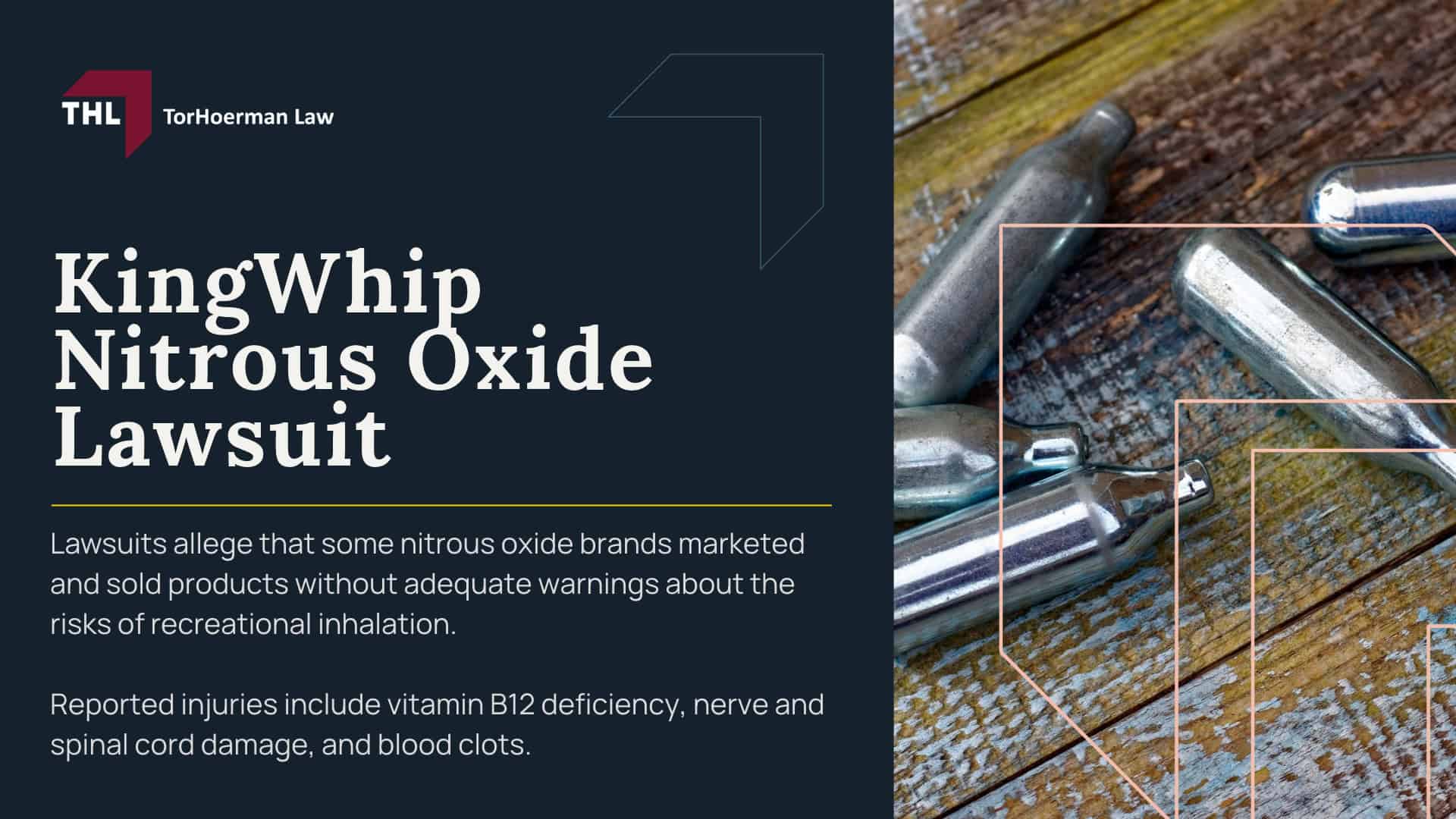
KingWhip cylinders are advertised for preparing whipped cream, foams, and drinks in professional kitchens, cafés, and homes.
Its 640-gram and 3.3-liter products appear on the Miami Magic and SupremeWhip U.S. retail sites, where customers can select individual cylinders or larger orders.
These King Whip cylinders hold far more nitrous oxide than the small cream chargers commonly used in whipped cream dispensers.
Australian companies appear in the KINGWHIP trademark history, and Miami Magic’s U.S. business has been named in nitrous oxide litigation.
Determining who made, imported, and sold a particular cylinder requires more than a trademark record or a retailer’s name.
Repeated nitrous oxide inhalation can cause neurological damage, including spinal cord injury, while oxygen deprivation and cold burns can occur during an individual episode.
Our attorneys assess the actual product, its distribution, the warnings available at purchase, and medical evidence when reviewing a potential nitrous oxide lawsuit.
If you or a family member suffered a serious injury after using KingWhip, contact us for a confidential consultation or use our chat feature.
Miami Magic lists a 640-gram KingWhip culinary gas cylinder containing food-grade nitrous oxide for whipped cream, desserts, and beverages.
The 3.3-liter KingWhip cylinder is labeled as a two-kilogram product, and its description specifies 2,050 grams of nitrous oxide.
Both listings describe connecting the cylinders to a compatible whipped cream dispenser with a hose and adapter.
The InfusionMax pressure regulator, which the retailer offers to control gas flow, is sold separately.
The retailer says a cylinder can turn 0.5 liters of cream into 1.5 liters of whipped cream and promotes the larger supply for repeated culinary preparations.
Compared with small, single-use nitrous oxide cartridges, a larger tank can supply multiple preparations without swapping chargers each time.
SupremeWhip’s U.S. catalog also lists both KingWhip sizes.
Miami Magic sells its own cylinders and other brands alongside KingWhip.
A store receipt may identify the seller without showing which brand the customer bought; an itemized order or photo can resolve that question.
The current KingWhip listings restrict the cylinders to food and beverage use, give handling instructions, and describe California age checks and misuse disclaimers.
The warnings on the cylinder and the sales information available when it was purchased matter to a potential claim.
An older order may have carried different language from the listing available today.
The KingWhip listings do not describe flavored gas, although the retailer carries flavored nitrous oxide products under other names.
The KINGWHIP U.S. trademark record, serial number 98421180, identifies Commerce Enterprises Pty. Ltd. of Australia as the original registrant.
The application was filed in February 2024 and the mark was registered in May 2025 for goods that include nitrous oxide-filled cylinders and culinary equipment.
The record later identifies CE Brand Holdings Pty Ltd of Australia as a new owner after registration.
Australia’s business register also lists Miami Magic among the business names of Commerce Enterprises Pty. Ltd.
Separately, a U.S. federal court identified Commerce Enterprises Inc. as a defendant in a nitrous oxide case involving products allegedly bought through Amazon.
Commerce Enterprises Pty. Ltd., CE Brand Holdings Pty Ltd, and Commerce Enterprises Inc. have distinct legal names and roles in the available records.
Trademark ownership does not establish who filled, imported, or sold a particular cylinder in the United States.
Packaging, invoices, import records, and order information may identify the businesses involved in an individual purchase.
In a 2026 federal product liability case, Todd v. Amazon.com Services, LLC, No. 2:26-cv-00278, the plaintiff alleges injuries from recreational use of flavored nitrous oxide products bought through third-party sellers on Amazon.
A federal court order identifies Commerce Enterprises Inc. among the defendants.
A separate January 2026 complaint in King County Superior Court, Lira et al. v. Amazon.com Services LLC et al., No. 26-2-03961-5 SEA, names Commerce Enterprises Inc. doing business as Miami Magic.
The plaintiffs allege that defendants sold or promoted nitrous oxide online without adequate warnings about the risks of recreational inhalation.
Neither filing names KingWhip or establishes that the plaintiffs used a KingWhip cylinder.
A separate KingWhip claim would need evidence identifying the product, its seller, and the conduct alleged to have caused the injury.
The FDA’s nitrous oxide advisory warns consumers not to inhale nitrous oxide from chargers, canisters, or tanks of any size.
It lists possible effects including vitamin B12 deficiency, nerve damage, blood clots, frostbite, impaired bowel or bladder function, paralysis, loss of consciousness, and death.
The published list names Miami Magic and other brands, but does not name KingWhip.
The FDA says nitrous oxide products are sold online and through gas stations, smoke shops, and vape shops.
A CDC report describes recreational nitrous oxide use among teenagers and young adults.
The advisory applies to recreational nitrous oxide inhalation regardless of brand or cylinder size. It is not a recall or a finding about a particular KingWhip cylinder.
Nitrous oxide, sometimes called laughing gas, has controlled medical and dental uses as well as culinary applications.
Inhaling gas from a culinary cylinder for a recreational effect can cause serious harm.
Recreational inhalation can displace oxygen, causing loss of consciousness, falls, or brain injury.
Gas released quickly from a pressurized cylinder can also cause cold burns to the lips, mouth, or airway.
Repeated nitrous oxide use can inactivate vitamin B12 and injure the nervous system, causing numbness, muscle weakness, trouble walking, and peripheral neuropathy.
With substantial exposure, a person may develop spinal cord degeneration and other spinal cord damage.
A clinical review notes that serum vitamin B12 can appear normal despite functional deficiency; clinicians may also consider homocysteine, methylmalonic acid, MRI findings, and nerve conduction studies.
Persistent symptoms may require rehabilitation, and some people suffer lasting neurological injury or permanent nerve damage.
Heavy use has also been associated with deep vein thrombosis and pulmonary embolism.
Medical records can help connect a person’s symptoms to nitrous oxide exposure, while packaging and purchase records can identify the brand used.
New weakness, trouble walking, chest pain, or shortness of breath after inhaling nitrous oxide warrants prompt medical care.
We review where the cylinder was purchased, what warnings were available, when it was used, and how the symptoms developed.
The exact product matters because one seller may carry cylinders with different labels and suppliers.
Useful evidence may include:
A claim may allege inadequate warnings or misleading sales statements by a company involved in making, distributing, or selling the identified cylinder.
The label and sales page available at the time of purchase can help evaluate such a claim.
Food-grade nitrous oxide is intended for culinary use and can cause serious harm when inhaled recreationally.
Evidence of what a company knew about misuse, along with its warnings and sales practices, may bear on responsibility.
Liability depends on the applicable law, the conduct of each company, and whether the alleged failure contributed to the injury.
A person seriously injured after inhaling nitrous oxide from a KingWhip cylinder may have a personal injury claim if the medical records, product identification, and a company’s alleged conduct support it.
Wrongful death claims may be available to eligible family members or estate representatives if a person died after using the product and the evidence supports a claim under state law.
Potential damages may include medical expenses, rehabilitation, lost income, future care, pain and suffering, and other losses supported by the evidence.
Filing deadlines depend on the state and type of claim.
We are reviewing serious injury and death claims allegedly connected to recreational inhalation of KingWhip nitrous oxide products.
Our attorneys assess the product, seller, warnings, medical records, and each company’s role in bringing the cylinder to market.
Contact TorHoerman Law for a free consultation or use our chat feature.
U.S. retailer listings describe a 640-gram cylinder and a 3.3-liter cylinder labeled as a two-kilogram product with 2,050 grams of nitrous oxide.
The label and receipt can establish which one a purchaser received.
No.
Miami Magic’s online store sells KingWhip alongside its own cylinders and other brands.
The itemized order, product packaging, or a photo can help identify the cylinder purchased.
The Todd federal case and Lira state complaint name Commerce Enterprises Inc. doing business as Miami Magic, but neither names KingWhip.
Evidence of a particular person’s use of KingWhip would be needed to assess a brand-specific injury claim.
The FDA advises against recreational inhalation of nitrous oxide in any size cylinder or charger.
Its advisory does not name KingWhip and was not a recall of the brand’s products.

Tor Hoerman has represented injured individuals for more than 30 years, with experience spanning individual personal injury cases and nationwide mass tort litigation. His work includes car accidents, catastrophic injuries, product liability claims, and other serious injury cases. Tor has served in court-appointed leadership roles in national litigation and tried cases involving major corporate defendants.
TorHoerman Law’s legal content is researched and written by our editorial team and attorneys for legal accuracy, clarity, and relevance. We rely on statutes, court records, government publications, medical research, and other authoritative sources when applicable. This page provides general legal information and does not constitute legal advice.
TorHoerman Law reviews its legal content for factual accuracy, current information, and relevant legal context before publication and as material developments occur. This article is provided for general informational purposes and does not constitute legal advice. For guidance about a specific case, contact TorHoerman Law.
You can learn more about this topic by visiting any of our Nitrous Oxide Lawsuit pages listed below:
A serious injury can change your life.

TorHoerman Law represents people whose lives have been disrupted by serious injuries, unsafe products, and negligence. Our attorneys handle individual personal injury cases as well as national mass tort lawsuits involving major corporations.
Founded in 2009, our legal team brings more than 100 years of combined experience handling serious injury and complex civil litigation.
Do you believe you’re entitled to compensation?
Use our Instant Case Evaluator to find out in as little as 60 seconds!

In this case, we obtained a verdict of $495 Million for our client’s child who was diagnosed with Necrotizing Enterocolitis after consuming baby formula manufactured by Abbott Laboratories.

In this case, we were able to successfully recover $20 Million for our client after they suffered a Toxic Tort Injury due to chemical exposure.

In this case, we were able to successfully recover $103.8 Million for our client after they suffered a COX-2 Inhibitors Injury.

In this case, we were able to successfully recover $4 Million for our client after they suffered a Traumatic Brain Injury while at daycare.

In this case, we were able to successfully recover $2.8 Million for our client after they suffered an injury due to a Defective Heart Device.
A serious injury can change your life.