Active Litigation
Nitrous Oxide Lawsuit Facts
TorHoerman Law is actively accepting claims for the Nitrous Oxide Lawsuit.

Active Litigation
TorHoerman Law is actively accepting claims for the Nitrous Oxide Lawsuit.
A Nitrox nitrous oxide lawsuit may allege that a manufacturer, distributor, or seller failed to warn about serious injuries from foreseeable recreational use of NITROX products.
U.S. retailers have listed 8-gram NITROX cream chargers and larger, flavored 640-gram cylinders.
The FDA added NITROX to its nitrous oxide inhalation warning in June 2025, and Health Canada later identified Nitrox chargers in two Canadian recalls.
A January 2026 Washington lawsuit names an unidentified company doing business as NITROX, but no named plaintiff lists the brand among the products they report using.
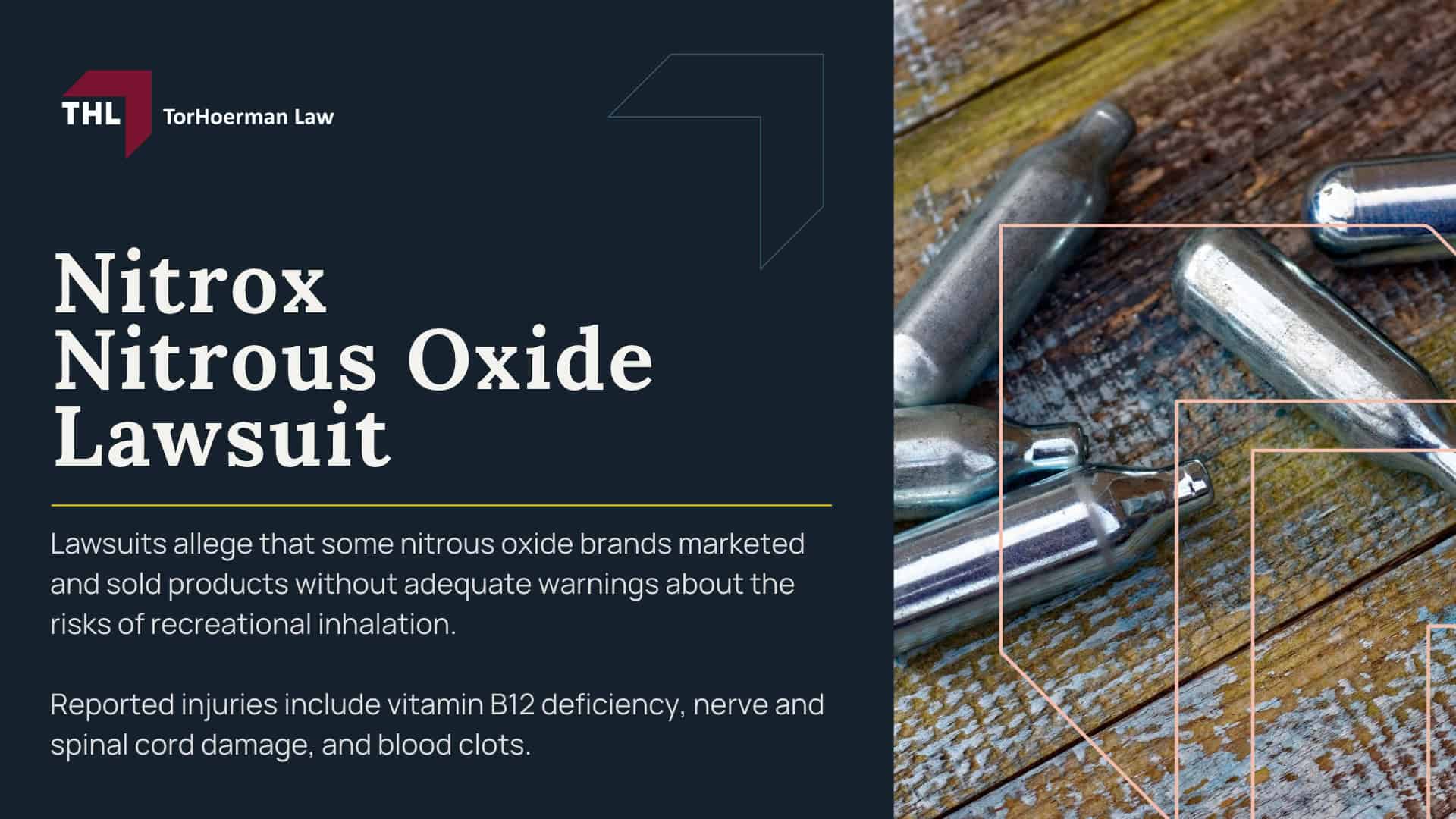
Retailers have advertised 8-gram NITROX cream chargers and flavored 640-gram cylinders for food preparation.
Packaging and purchase records can help identify the product and the seller involved in a claim.
The FDA’s nitrous oxide advisory warns that recreational inhalation can cause vitamin B12 deficiency, nerve damage, blood clots, frostbite, oxygen deprivation, and death.
In a Washington lawsuit, plaintiffs allege that Amazon and several nitrous oxide manufacturers and sellers failed to warn about the risks of recreational inhalation.
The complaint names the NITROX defendant as an unidentified Doe entity.
Our attorneys review the product, warnings, seller, medical records, and any use of other brands when evaluating a potential nitrous oxide lawsuit.
Contact TorHoerman Law for a free consultation or use our chat feature to discuss a potential claim.
NITROX cream chargers are marketed for whipped cream preparation and other culinary uses.
A wholesale listing describes steel nitrous oxide cartridges holding 8 grams of food-grade gas each and sold in boxes of 24.
Another retailer lists 640-gram NITROX cylinders in strawberry, watermelon, and unflavored versions for foodservice.
A smoke and vape wholesaler has also advertised 8-gram NITROX chargers in mango, pineapple, strawberry, and watermelon flavors.
Retailer listings do not establish who made a purchaser’s NITROX product or which warnings appeared on its packaging.
Packaging and lot markings can help identify the product, while receipts and order records can establish where it was purchased.
The FDA warns consumers against inhaling nitrous oxide products sold under the NITROX name.
Health Canada has recalled affected Nitrox chargers sold for inhalation without Canadian market authorization.
The Canadian notices name different distributors for recalls published in December 2025 and May 2026.
Those Canadian notices do not identify the companies involved in an individual U.S. sale.
Neither action establishes that a specific NITROX product caused an injury.
The FDA first warned against recreational nitrous oxide inhalation in March 2025 and added NITROX to its advisory on June 4, 2025.
The warning applies to flavored and unflavored nitrous oxide chargers, canisters, and tanks of any size.
The FDA identifies serious health risks of nitrous oxide misuse, including numbness, limb weakness, impaired bowel or bladder function, paralysis, psychiatric symptoms, blood clots, frostbite, and asphyxiation.
People who regularly inhale nitrous oxide may experience prolonged neurological effects, including spinal cord or brain damage after they stop using it.
The FDA identifies online marketplaces, smoke shops, vape shops, and gas stations as places where nitrous oxide products are sold.
The FDA advisory is not a U.S. recall of NITROX products.
Health Canada’s December 9, 2025 recall identifies strawberry and watermelon Nitrox cream chargers supplied by West Coast Gifts Incorporated.
A second Canadian recall published May 11, 2026 lists Nitrox nitrous oxide chargers without specifying a flavor and identifies Smoke Arsenal as the recalling company.
Both recalls concern affected products sold for inhalation without the required Canadian market authorization.
The Canadian notices do not establish either company’s role in a U.S. sale or identify a manufacturing defect in a U.S. product.
The complaint filed January 28, 2026, in Lira et al. v. Amazon.com Services LLC et al., King County Superior Court case 26-2-03961-5 SEA, names “Doe Entity 2 d/b/a NITROX” among numerous defendants.
The filing does not identify that defendant’s legal name or place of business.
The plaintiffs allege that Amazon and other nitrous oxide manufacturers and sellers failed to adequately warn about the risks of foreseeable recreational inhalation.
An exhibit lists the brands each plaintiff reported using and states that the lists are nonexhaustive.
None of the named plaintiffs lists NITROX in that exhibit.
Product and transaction records may help identify the company behind a particular NITROX charger and establish whether an injured person used it.
Nitrous oxide, sometimes called laughing gas, has culinary and supervised medical uses.
Recreational inhalation can deprive the body of oxygen, and contact with pressurized gas can cause cold burns.
Repeated exposure can injure the nervous system.
A diagnosis of a nitrous oxide-related injury does not identify the brand used or the business responsible for the sale.
Repeated inhalation can inactivate vitamin B12 and injure nerves and the spinal cord, affecting sensation, balance, and movement.
Numbness, tingling, limb weakness, an unsteady gait, and difficulty walking may indicate peripheral neuropathy or spinal cord damage.
Severe neurological injury can involve spinal cord degeneration, impaired bowel or bladder function, loss of mobility, or partial paralysis.
A clinical review of nitrous oxide toxicity notes that neurological symptoms can develop after weeks to months of frequent use and that vitamin B12 blood levels may appear normal despite a functional deficiency.
Clinicians may also assess methylmalonic acid, homocysteine, MRI findings, and nerve function.
Medical treatment generally includes stopping nitrous oxide use and replacing vitamin B12, with rehabilitation when neurological injuries limit movement or daily activities.
People struggling with nitrous oxide addiction may also need substance use treatment or psychological support.
Some people have lasting symptoms despite treatment.
Inhaling nitrous oxide without adequate oxygen can cause loss of consciousness, falls, asphyxiation, or brain injury.
Rapid release of gas from a pressurized charger or cylinder can also cause frostbite or cold burns.
Clinical reports have described deep vein thrombosis and pulmonary embolism after heavy nitrous oxide use.
Other clotting risks and medical conditions must be assessed before attributing a particular blood clot to nitrous oxide exposure.
Anyone experiencing new weakness, trouble walking, chest pain, or shortness of breath after inhaling nitrous oxide should seek medical care and tell the treating clinician about the exposure.
We review the product and its warnings, purchase history, and medical records to identify the businesses involved and assess the injury.
Relevant evidence may include:
Packaging and purchase records may identify the manufacturer, brand owner, importer, distributor, retailer, or online seller involved in a particular transaction.
A claim may allege that a manufacturer or seller failed to warn about foreseeable inhalation or made misleading statements about product safety.
Liability depends on the applicable law, what each company did, and whether its alleged conduct contributed to the injury.
A person who developed lasting neurological damage, a serious blood clot, or an injury from oxygen deprivation after using NITROX may have a claim if the evidence connects the product and alleged misconduct to that injury.
Eligible relatives or estate representatives may bring wrongful death claims if a death and a company’s legal responsibility can be established under applicable state law.
Depending on the evidence and state law, a successful claim may recover damages for medical costs, rehabilitation, lost income, reduced earning capacity, physical pain, and lasting disability.
There is no established settlement range for Nitrox lawsuits.
Filing deadlines depend on the state, type of claim, and relevant injury or death date.
We are reviewing claims involving serious injuries and deaths after recreational inhalation of NITROX products.
Our attorneys assess product identification, warnings, medical records, and each company’s role in the supply chain.
Contact TorHoerman Law for a free consultation or use our chat feature.
U.S. retailer listings describe both 8-gram NITROX cream chargers and 640-gram NITROX cylinders.
The package and purchase records should establish the specific size and product involved in a claim.
The FDA added NITROX to its June 2025 advisory warning against inhaling nitrous oxide products.
That advisory was not a U.S. recall of NITROX products.
Yes.
Health Canada listed strawberry and watermelon Nitrox cream chargers in a December 2025 recall and Nitrox nitrous oxide chargers without specified flavors in a May 2026 recall.
Both notices concerned affected products sold for inhalation without the required Canadian market authorization.
No.
The complaint names an unidentified NITROX business, but its nonexhaustive list of products reported by the named plaintiffs does not identify a NITROX product.
An individual claim requires evidence of the actual product used and its connection to a medically documented injury.
Possibly.
Use of other brands can complicate product identification and medical causation, but it does not automatically bar a claim.
Purchase records, packaging, exposure dates, and the timing of symptoms can help clarify the role of each product.

Tor Hoerman has represented injured individuals for more than 30 years, with experience spanning individual personal injury cases and nationwide mass tort litigation. His work includes car accidents, catastrophic injuries, product liability claims, and other serious injury cases. Tor has served in court-appointed leadership roles in national litigation and tried cases involving major corporate defendants.
TorHoerman Law’s legal content is researched and written by our editorial team and attorneys for legal accuracy, clarity, and relevance. We rely on statutes, court records, government publications, medical research, and other authoritative sources when applicable. This page provides general legal information and does not constitute legal advice.
TorHoerman Law reviews its legal content for factual accuracy, current information, and relevant legal context before publication and as material developments occur. This article is provided for general informational purposes and does not constitute legal advice. For guidance about a specific case, contact TorHoerman Law.
You can learn more about this topic by visiting any of our Nitrous Oxide Lawsuit pages listed below:
A serious injury can change your life.

TorHoerman Law represents people whose lives have been disrupted by serious injuries, unsafe products, and negligence. Our attorneys handle individual personal injury cases as well as national mass tort lawsuits involving major corporations.
Founded in 2009, our legal team brings more than 100 years of combined experience handling serious injury and complex civil litigation.
Do you believe you’re entitled to compensation?
Use our Instant Case Evaluator to find out in as little as 60 seconds!

In this case, we obtained a verdict of $495 Million for our client’s child who was diagnosed with Necrotizing Enterocolitis after consuming baby formula manufactured by Abbott Laboratories.

In this case, we were able to successfully recover $20 Million for our client after they suffered a Toxic Tort Injury due to chemical exposure.

In this case, we were able to successfully recover $103.8 Million for our client after they suffered a COX-2 Inhibitors Injury.

In this case, we were able to successfully recover $4 Million for our client after they suffered a Traumatic Brain Injury while at daycare.

In this case, we were able to successfully recover $2.8 Million for our client after they suffered an injury due to a Defective Heart Device.
A serious injury can change your life.