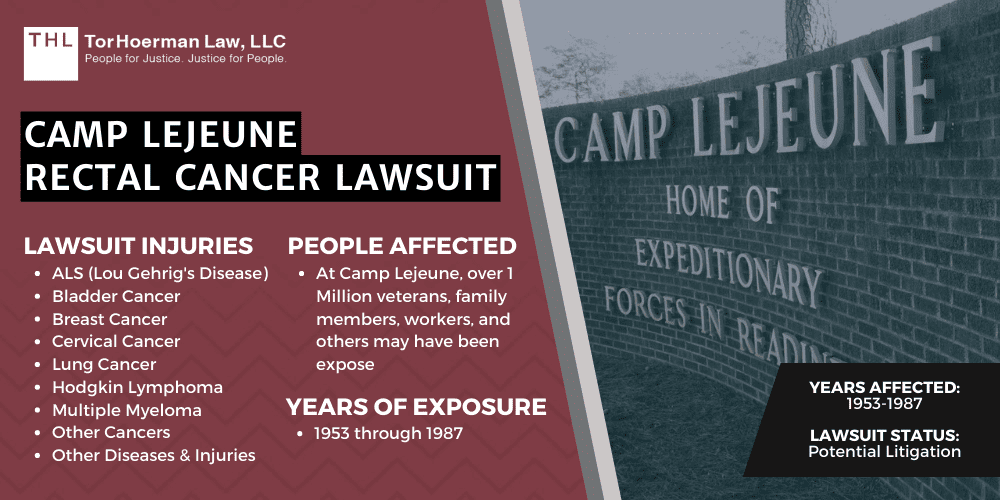
An increased risk of rectal cancer has been identified by medical professionals who’ve studied the contaminated water at Camp Lejeune as a particularly common diagnosis.
The Agency for Toxic Substances and Disease Registry (ATSDR) conducted many scientific studies on the Camp Lejeune water supply, and found that residents with long-term exposure suffered from higher rates of rectal cancer, prostate cancer, kidney cancer, liver cancer, and many other deadly forms of cancer.
About Rectal Cancer
The rectum is the lower part of the large intestine, located just above the anus.
Tumor growths in the rectum may be benign if they are localized.
In other words, they pose no threat and will not spread.
However, these tumors become malignant when they begin to metastasize or spread to other parts of the body.
Malignant rectal cancer can be debilitating and life-threatening.
Malignant rectal cancer cells can spread to parts of the body like the large intestine and colon.
Besides the colon, cancer cells from the rectum can also spread to the heart and lungs.
Based on several studies, rectal cancer can also spread to the peritoneum, which is the abdominal lining that protects organs like the stomach and intestines.
Rectal cancer has a high survival rate if it is localized: 90% of individuals survive rectal cancer if it has not spread to other parts of the body.
The survival rate of the disease decreases based on several factors. According to a 2022 study, older patients are more likely to suffer from complications, especially after surgery.
Cancer inside the rectum and cancer inside the colon are often grouped together as “Colorectal Cancer“.
Symptoms of rectal cancer may include:
- Blood in the stool or bleeding from the rectum
- Changes in bowel habits, such as persistent diarrhea or constipation
- Abdominal discomfort or pain
- Unexplained weight loss
- Weakness, fatigue
Rectal Cancer Complications
If rectal cancer is not promptly treated, it can lead to significant complications:
- Spread of cancer cells to other parts of the body (metastasis)
- Obstruction or blockage of the rectum or colon
- Bowel incontinence, the inability to control bowel movements
As with prostate cancer, it is important to note that the seriousness of rectal cancer should not be underestimated, even though treatment options and survival rates have improved over time.
It is recommended that individuals over the age of 50, or those with a family history of colorectal cancer, undergo regular screenings such as colonoscopies to detect and prevent rectal cancer.