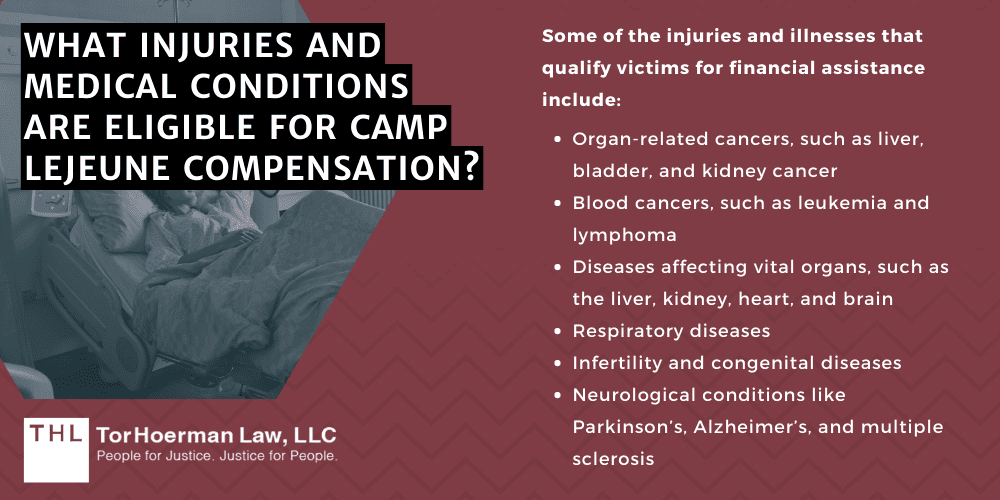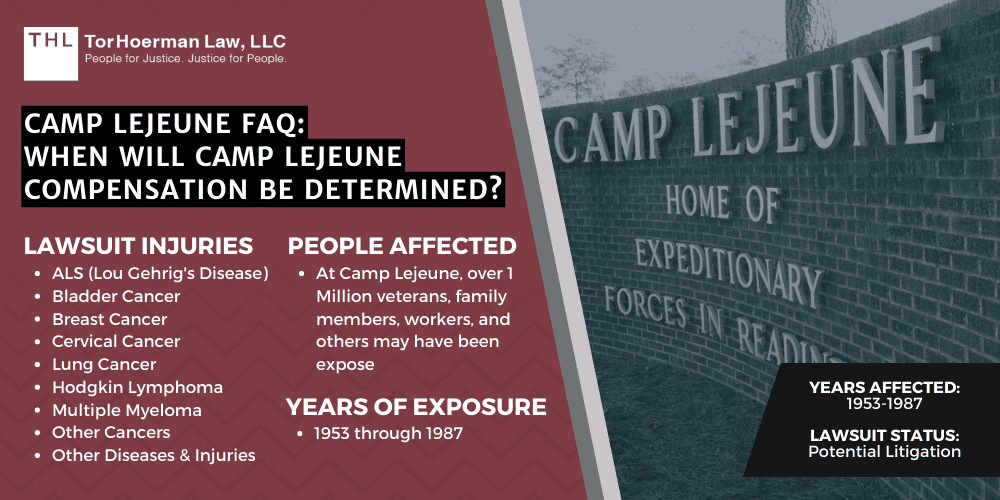
From the early 1950s to the late 1980s, Camp Lejeune residents and workers were exposed to high levels of volatile organic compounds and other toxic substances in the Camp Lejeune water supply, which caused many to develop cancer and other life-threatening health conditions.
The Camp Lejeune water supply — specifically from the Tarawa Terrace and Hadnot Point treatment plant — was contaminated for decades from multiple sources.
One of the primary causes of the water contamination was a privately-owned dry cleaning service outside the U.S. Marine Corps Base Camp.
Toxic chemicals, such as Tetrachloroethylene (PCE), Trichloroethylene (TCE), Vinyl Chloride, Benzene, and up to 70 other contaminants leaked into the Camp Lejeune water supply at unregulated levels.
You can learn more about the dangerous chemicals present, and what caused the contaminated water supply at Camp Lejeune, here.
Attempts at Justice for Camp Lejeune Victims Pre-2022
Despite the breadth of people impacted by the toxic water at Camp Lejeune, little legislative action was undertaken to care for them.
In 2012, over 30 years after the water contamination ceased, the Janey Ensminger Act was implemented.
Named after the daughter of a Marine Corps veteran who passed due to illnesses contracted from the contaminated water, the Janey Ensminger Act sought to allow victims to recover medical assistance for their conditions.
Unfortunately, this act did not have the widespread impact that was needed.
Victims used to rely on the Federal Tort Claims Act of 1946 to hold the government accountable for what happened, but this didn’t always end in their favor.
According to the Navy JAG, claims filed under the Federal Tort Claims Act were dismissed in 2016 by the MDL court because:
“…the conditions required for a waiver of sovereign immunity had not been met. In other words, the claims could not be considered; therefore, there is no legal basis to pay them.”
It wasn’t until August 2022 that Camp Lejeune veterans, family members, civilian workers, and others who were at Camp Lejeune between 1953 and 1987 could get the justice they deserve.
With the Camp Lejeune Justice Act of 2022, victims can now file a formal complaint specific to their situation with greater chances of success.
The Camp Lejeune Justice Act: How Military Veterans and other Camp Lejeune Residents Can Get Compensated
The Camp Lejeune Justice Act was signed into law by President Biden in August 2022 as part of the Honoring Our PACT Act.
The Camp Lejeune Justice Act allows military personnel, military veterans, their family members, civilian workers, and any person who was at Camp Lejeune for 30 days or more between 1953 and 1987 to file an administrative claim with the Navy JAG.
Camp Lejeune Justice Act claims include:
- Information on illnesses linked to Camp Lejeune water contamination
- Personal information
- Settlement demands
The submission of a Camp Lejeune Justice Act claim can be done with the help of a law firm or legal representative, or by individuals and family representatives.
The Navy JAG has six (6) months to adjudicate or settle a Camp Lejeune Justice Act claim.
If a solution is not found within those 180 days, Camp Lejeune victims have the right to file a lawsuit in the US District Court for the Eastern District of North Carolina.